

City Codex · Revised November 2026
Valencia Relocation Codex
The Mediterranean Corridor — The City That Remembers Water
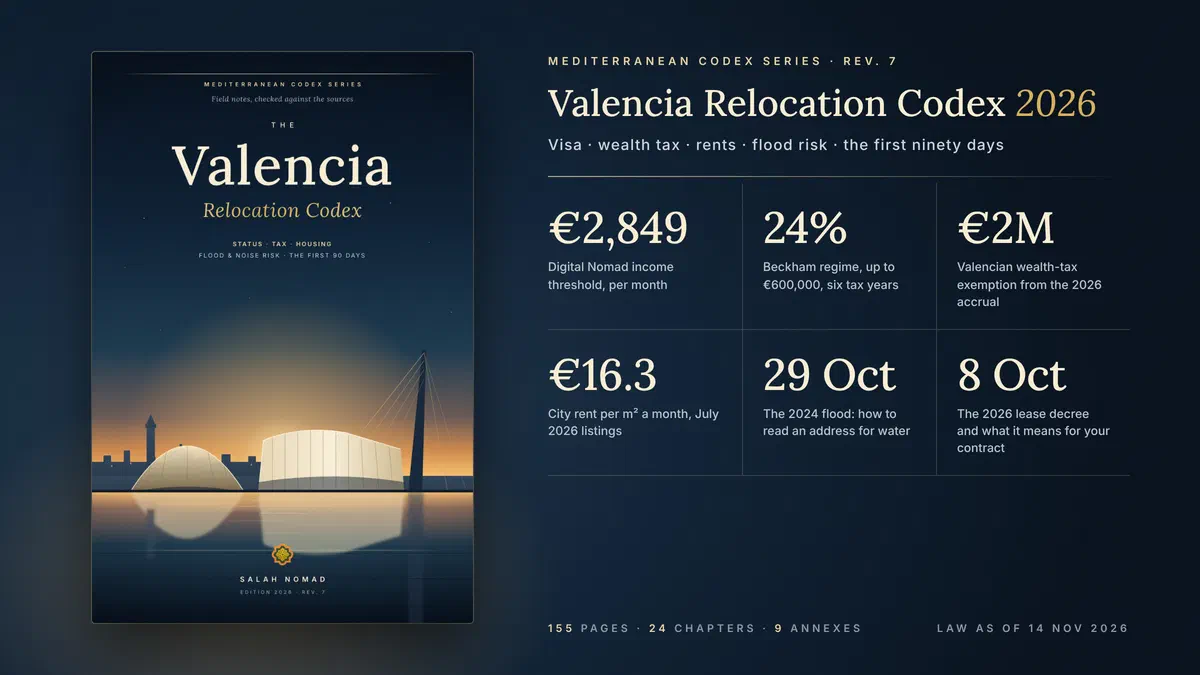
The Valencia Relocation Codex is a 155-page, 24-chapter guide for remote workers, founders and investors moving to Valencia, Spain. It covers the Digital Nomad residence route (the €2,849 monthly income threshold for 2026, derived from the €1,221 minimum wage in Royal Decree 126/2026, the supplements for a partner and each dependant, the 20% limit on Spanish clients for the self-employed, a consular visa of up to one year versus an in-Spain authorisation of up to three years), the Beckham regime (24% up to €600,000 and 47% above, six tax years, the five-year non-residence condition and Form 149 within six months of Social Security registration), tax residence and the 183-day test, and what Valencia does to the rest: the regional wealth-tax exemption of €1 million for 2025 and €2 million from the 31 December 2026 accrual under Law 5/2026, and the regional income-tax cut. It explains the flood of 29 October 2024 and how to read an exact address for water, how Consorcio flood cover really works for a tenant, the Ruzafa acoustic-saturation zone in force since 20 May 2026, the rental market (about €16.3 to €16.6 per square metre in 2026 listings, about €1,254 for an average one-bedroom, district figures from Ciutat Vella to Patraix), the lease rules (one-month deposit, agency fees on the landlord, the October 2026 decree-laws: 29/2026 validated on 12 November, 28/2026 repealed), a winter and summer budget, an arrival buffer of about €8,250, health cover, banking, schools, pets and driving, the Valencian year, and the first week, month and ninety days. Appendices give checklists, a viewing scorecard, worksheets, a documents reference, sources, a glossary, an annual calendar, a correction log and a twelve-month plan. Law and data are read as of 14 November 2026 and every claim carries an A, B or C grade. It recommends no lawyer, agent or bank and takes no commission. It is educational material, not legal, tax or immigration advice.
- Length
- 155 Pages
- Revised
- Nov 2026
- Format
- Delivery
- Instant link
Why this manual exists
Valencia is easy to love from a photograph and easy to rent badly from one. It is a city with a beach inside its limits, a river-bed garden that crosses it, and a daily life you can run on foot or by bike. It is also a city that lived through the flood of 29 October 2024, where rents have risen faster than wages for six years, where the nightlife of its best-known district is now under an acoustic-saturation order, and where the rules on renting a flat were rewritten in October 2026. The expensive mistakes here are quiet ones: a ground-floor lease with no contents policy, a visa threshold calculated on the wrong base, a tax election missed by a week, a flat that is 30 degrees at midnight.
Then, in 2026, the ground rules moved. The Digital Nomad threshold was set at €2,849 a month. Valencia raised its wealth-tax exemption to €2 million from the 2026 accrual. A housing decree took effect on 8 October and was validated on 12 November, while its companion was repealed. Spain votes on 29 November. And much of what the August edition of this guide said about named professionals, flood clauses and visa figures could not be confirmed.
The Valencia Relocation Codex is a 155-page, 24-chapter guide for the person who has not yet signed. It is built in six parts and 24 chapters, in the order in which decisions must be taken: the decision, status and tax, housing, setting up, daily life, and execution and exit. Every chapter opens with the question it answers, what to obtain first and the condition on which to stop, and ends with what changed, what to do and what remains unconfirmed. Parts I to IV close with a gate you must pass before you go on.
What it settles
- Whether Valencia fits. The city on the numbers, a comparison with Madrid, Barcelona and Málaga, and a first filter you can answer in writing before you read further.
- What the water means for you. The 2024 flood in context (Chapter 3), how to read an exact address against the official hazard maps, and how Consorcio cover works for a tenant, with the earlier edition’s unsourced list of “excluded postcodes” withdrawn.
- Which route, and in what order. The €2,849 Digital Nomad threshold and where it comes from, the household table, the 20% limit on Spanish clients, consulate versus in-Spain filing and the paperwork chain from NIE to health card.
- When the Beckham clock starts. 24% up to €600,000 for six tax years, who qualifies, the freelancer question and the six-month window, set beside the Valencian wealth-tax exemption of €2 million from 31 December 2026 and the regional income-tax cut.
- What a flat really costs and whether it will cook you. Dated rent figures by district, a rental dossier that gets you viewings, the three building tests (water, heat, noise), a lease checklist and the October 2026 decree-laws in plain terms.
- What a month costs. A winter and summer budget built line by line, three household profiles and an arrival buffer of about €8,250.
- How to land and live. Health cover, banking, schools, pets and the car, a twelve-week programme of local rituals, the Valencian year, the first week, month and ninety days, and how to renew, leave or fail safely.
Dated and graded
Spanish rules are cheap to quote and expensive to get wrong. So every legal or numerical claim carries a grade: A for a primary source, B for consistent secondary sources or a figure derived from a grade A one, C for judgement or an estimate. Where something could not be confirmed, the guide says so rather than rounding it into a fact. Rev. 7 replaces the August 2026 edition, and Appendix H lists every claim that was corrected, removed or added, so that nothing you may have read before goes unflagged. The Method page prints the exact count of graded claims in the book, computed from the sources.
Tools you can use on Monday
Appendix A is the gate sheet: four gates, one page, with the date you met each condition. Appendix B holds a fifteen-line viewing scorecard, the rental dossier and the move-in kit. Appendix C gives the budget worksheet and the formulas for the visa threshold, the Beckham flat tax and the arrival buffer, which you can work out by hand. Appendix D is the document and deadline register, Appendix E five short letters and clauses in Spanish and English (a landlord cover note, a request for registration documents, a written request for flood cover, a request for the reason of a seasonal contract and lease clauses), Appendix F the sources directory, Appendix G the glossary and annual calendar, Appendix H the correction log and a local annex gives the first twelve months and the day trips.
Written for people whose income lives somewhere else
If you work for a company abroad, invoice clients in several currencies or run a business from a laptop, Chapters 4 to 8 matter most. If you are an EU or EEA citizen, skim Chapter 5 and keep the rest. If your questions are about crypto tax, wealth-tax valuation or proving the source of funds, this guide is the practical groundwork, and the Beckham Law Codex, Spanish Wealth Tax & Crypto, Before You Land and Source of Funds Dossier go deep. A US citizen should add the US Citizen Spain Bridge. Thinking of buying rather than renting? The Landing Protocol is the property decision file. Comparing cities first? The Málaga Codex and the Madrid Codex are the natural pair.
What it will not do
It will not tell you whether Valencia is right for you, whether a position is safe on your facts or what an office will accept. It does not cover buying property, crypto taxation or US citizenship-based taxation. It recommends no lawyer, agent, bank, insurer or coworking space and takes no referral fees. It forecasts neither an election nor a rainstorm. It does not replace a registered Spanish lawyer, gestor and tax adviser. It improves the questions you ask and the evidence you hold when you ask them.
Inside the manual
- 1
Is Valencia Your City?
The city on the numbers against Madrid, Barcelona and Málaga, what it is not, and a worked exercise to find the one thing you will not trade.
- 2
The Five Mistakes
The five errors that cost newcomers most, each set against the facts: the uncovered flood, the Ruzafa premium, the padrón wait, the top-floor oven and the expat bubble, plus a sixth about signing under pressure.
- 3
The Local Risk Map
The flood of 29 October 2024, how to test an exact address against the hazard maps, how Consorcio cover works for a tenant, heat, the acoustic-saturation zones and tourist flats. It ends with Gate I.
- 4
Routes to Residence
Seven doors into Spain in one table, which fits which person, what the teleworker route is not, and why the golden visa is gone.
- 5
The Digital Nomad Residence, Step by Step
The €2,849 threshold and where it comes from, the household table, the variant that circulates, what the authority checks, consulate versus in-Spain filing, the 20-working-day legal clock and a realistic timeline.
- 6
Tax Residence and the Regional Layer
The 183-day test, what Valencia adds (the wealth-tax exemption of €2 million from the 2026 accrual and the regional income-tax cut), the information returns and where the layer applies to you.
Show the other 19 chapters
- 7
The Beckham Regime
24% to €600,000 for six tax years, who qualifies, the Form 149 deadline, and a worked comparison with the ordinary scale that shows where the flat rate starts to pay.
- 8
Employee, Autónomo or Company
Three vehicles for the same laptop: the 2026 autónomo brackets and flat rate, the company in one paragraph, a choice table by profile, and Gate II.
- 9
The Rental Market in Numbers
Dated readings from three data houses, district prices, what the average one-bedroom means against the visa threshold, asking versus signed rents and a realistic timeline.
- 10
Lease Law 2026
What the law gives a tenant, the October 2026 decree-laws and the election that follows, what this edition deliberately does not print, and eight contract checks.
- 11
Searching, Reading a Building, Signing
The dossier, the three tests (water, heat, noise), the scams, and move-in day with the evidence that protects your deposit.
- 12
The Neighbourhood Atlas
Nine districts compared on character, rent and noise, with an honest note on which scores are measured, a five-step method to choose a street, and Gate III.
- 13
The Arrival Paperwork Sequence
Three fixed dependencies, the steps that can move, the padrón in practice, the Beckham clock and the documents most often missing.
- 14
Health and Insurance
The public system and the Valencian health card, what the residence file expects of a policy, how to compare one, and contents and liability cover.
- 15
Banking, Money and Foreign Assets
Opening an account, moving money, the money-laundering questions to expect and the information returns 720 and 721 with their thresholds and dates.
- 16
The No-Surprise Budget
A line-by-line monthly table for winter and summer with a chart, an arrival buffer of about €8,250, three household profiles, the one-third rule and Gate IV.
- 17
Getting Around
Metro, bus, bike and train, high-speed rail to Madrid in about 1 hour 50 minutes to 2 hours, the Albufera lines and the car you probably do not need.
- 18
Work, Internet and Utilities
Where to work, fibre checks, utilities, and a remote-work set-up that survives a heatwave, a bad connection and a blackout.
- 19
Families, Schools and Pets
A partner, children, nurseries, school language programmes, bringing a pet, exchanging a licence and insuring a car in a flood-hazard zone.
- 20
Safety, Scams and Emergencies
The numbers to save, ES-Alert and what to do on a flood alert, heat, petty theft and the scams to expect.
- 21
Language, Calendar and Belonging
Twelve weeks of rituals, the Valencian year with the 2027 dates for Fallas and Holy Week, the rules of the table and the words that open doors.
- 22
Choosing and Verifying Professionals
Why this edition names no one, the six-step method to choose your own, the official registers to check and the red flags.
- 23
The First Seven Days, Thirty and Ninety
A day-by-day first week, then the checklists for day thirty and day ninety, a weekly review and what to do when something goes wrong.
- 24
Renewing, Leaving and Plan B
Renewal in two-year steps, keeping the status, the exit checklist, switching cities and a three-part contingency plan for money, status and home.
- 25
Front matter and Appendices A to I
A method page with the published count of graded claims, a position-at-a-glance table, then the gate sheet, scorecard and dossier, budget formulas, the document and deadline register, five letters and clauses in Spanish, sources, glossary and calendar, a 22-line correction log and a local annex.
Is it for you?
Built for
- Non-EU remote workers and freelancers from the United States, the United Kingdom, Canada and Australia who want the visa threshold, the 20% client limit and the Beckham clock in the right order
- Founders, consultants and crypto holders whose income arrives from abroad and who want a liveable Mediterranean base, a regional wealth-tax settings check and a lease that survives scrutiny
- Couples and families who need schools, pets, the car and the household income test, not just a flat
- Anyone comparing Valencia with Málaga, Madrid or Barcelona on rent, noise, flood risk and tax before committing
- EU and EEA citizens, including readers from the Nordic countries, the Benelux and Ireland, who need the city, rent, lease, budget and first-ninety-days chapters; Chapters 4 and 5 are written for non-EU applicants and can be skimmed
Not for
- Anyone who needs a list of recommended lawyers, gestors, banks or agents: the guide names none as verified and teaches you to check your own
- Readers expecting crypto tax, wealth-tax computation or source-of-funds analysis: see the Beckham Law Codex, Spanish Wealth Tax & Crypto and the Source of Funds Dossier
- Buyers of property: this is a rental-and-residence guide, and the Landing Protocol covers buying
- US citizens who need citizenship-based tax filing: the US Citizen Spain Bridge is the dedicated manual
- Tourists looking for Fallas calendars or paella tours
- Readers who expect it to replace a registered Spanish lawyer, gestor or tax adviser

Written by Salah Nomad
Independent research. No commissions from any landlord, agent, lawyer, insurer, broker, bank or coworking space mentioned, and the guide recommends no professional: it teaches you how to verify one. Every claim is dated and graded A, B or C, and every correction to the August 2026 edition is listed in Appendix H.
Buying more than one?
- Ultimate Spain BundleMálaga + Valencia + Seville + Barcelona $219 Save $137
- Full Mediterranean Collection5 Cities + Algorithmic Sardines Ebook $269 Save $205
- Spain Complete SystemAll 7 Guides + Ebook $349 Save $303
- Málaga Relocation CodexThe Lighthouse $89
- Madrid Relocation CodexThe Continental Chess Game $89
- The Beckham Law CodexThe Impatriate's Protocol for Ley 28/2022 $99
- Spanish Wealth Tax & CryptoModelo 714, Modelo 718, and the 17-Region Matrix $129