

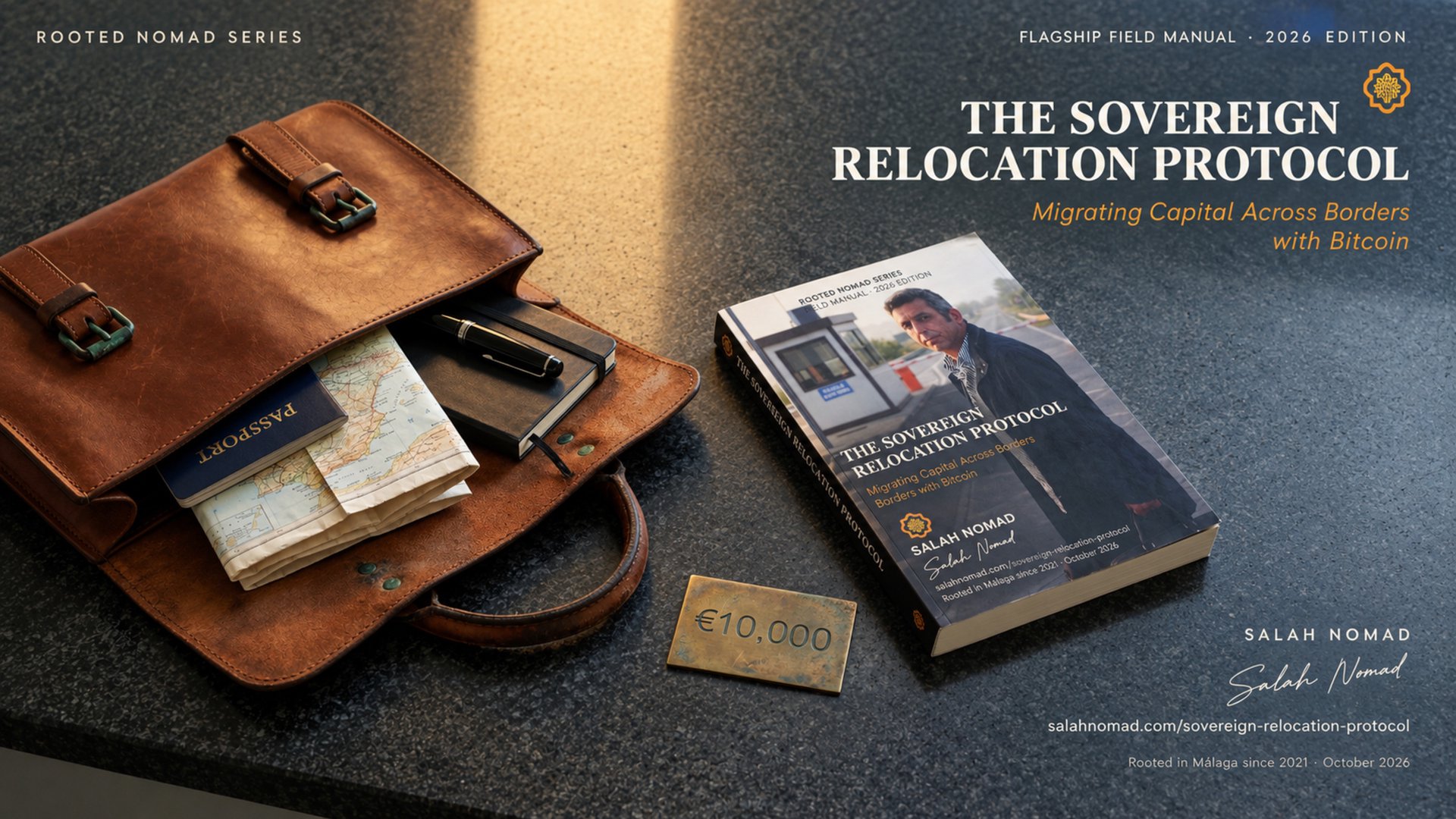

Bitcoin does not cross borders. Access does.
The private key in a safe in Málaga controls the same UTXO as the same key in a safe in Zürich. The asset is not imported, not declared, not seized. It is simply there, on the ledger, accessible from anywhere. What crosses the border is the device, the credential, the recovery phrase, the document, and the memory — the operative set that together constitute the ability to spend. The protocol is the operational answer to that distinction.
The hardware wallet does not travel. This is the book’s foundational rule. A Coldcard or Ledger in a carry-on bag triggers a four-question interview the traveler cannot control, in a zone where constitutional protections are weakened and the officer’s discretion is wide. The container is disposable. The architecture is not. The protocol builds the architecture — three keys across three jurisdictions, none of them carried by the traveler — and leaves the container at home.
The protocol is not a technique for evading the law. It is a technique for exercising rights the law already grants. Privacy is the act of declining to disclose what the law does not require you to disclose. Concealment is the act of hiding what the law requires you to declare. This book operates entirely in the first space, and it states the distinction on the introduction, on the disclaimer page, and again in every chapter that touches a counter.
🗂️ What the Protocol Covers
The €10,000 bearer instrument trap. Not about cash. About the definition of cash under Regulation (EU) 2018/1672 — prepaid cards, bearer securities, gold at 90 percent purity or higher, unsigned money orders. The regulation lets a customs officer retain funds above the threshold for up to 30 days, extendable to 90, without a criminal charge. The burden of proof that follows is the traveler’s. Chapter 1 maps the actual scope and the retention clock.
The border search doctrine. Six US circuits hold that a manual phone search requires no individualized suspicion. Two hold that reasonable suspicion is required, at least for forensic extraction. The UK can compel a PIN under Schedule 7, and refusal is a criminal offense under paragraph 18. France’s Cour de cassation held in its Assemblée plénière judgment of 7 November 2022 (No. 21-83.146) that a passcode is a convention secrète de déchiffrement only when the device contains data actually encrypted with it. Chapter 3 lays out all four positions and the practical consequence of each.
The multisig 2-of-3. Three keys, three jurisdictions. Key 1 in the departure country, on a SLIP-39-capable device that never travels. Key 2 with a co-signatory in a second jurisdiction. Key 3 in a Zurich or Liechtenstein safe deposit box. Any two of the three can spend; none alone. The encrypted reconstruction material of Key 1 crosses the border as ciphertext. The passphrase stays in memory. Chapter 10 builds the architecture from the SLIP-39 / BIP-39 incompatibility up, and states which path is canonical.
The duress wallet. A real wallet, funded between $500 and $5,000, presented to a private coercer as the traveler’s actual position. Two models: A1, derived from the same seed with an empty passphrase; A2, an independent seed. The trade-off is stated, not resolved — Model A1 is simpler to maintain but a coercer who knows the 25th-word architecture will ask for the passphrase; Model A2 separates the decoy from the vault but requires a second seed. Chapter 12 covers the case where the wallet does not apply: at the border, and against a state agent.
The zero-trace travel rig. Seven steps to a phone with no crypto application, no exchange 2FA, no financial application, no location history, no trip-specific messages. The restoration happens in a private room, hours after the counter. Chapter 13 documents the wipe protocol and the cloud fetch protocol, step by step, with the two-hour cost per trip broken down.
The counter script. Three rules. Answer the question asked. Do not volunteer, do not deny. Never answer “no” to a question whose true answer is “yes.” Chapter 16 gives the officer’s eight-question sequence and the factual response that closes each one without opening the next.
The ninety-day landing. European banks do not close crypto-adjacent accounts out of malice. They close them because of arithmetic — three transaction shapes that trip the monitoring software before a human reads the file. Chapter 19 dissects the freeze mechanism from the automated flag to the compliance decision. Chapter 23 gives the ninety-day schedule: the passive phase, the opening phase, the first conversion, the three-bank strategy.
The Spanish tax layer. Every conversion is an event. FIFO decides which coins were sold. The Modelo 720 triggers at €50,000 per category. The Modelo 721 covers virtual currencies held with a provider abroad. Spain and Switzerland exchange CRS information; Spain and Liechtenstein exchange CRS information. The exit tax under Article 95 bis LIRPF targets shareholdings, not direct self-custody — the distinction is documented in Chapter 26, the longest chapter in the book, and the one most relocation guides omit entirely.
📘 What’s Inside
Inside This Codex — 33 Chapters
The actual scope of Regulation (EU) 2018/1672. Prepaid cards, gold purity thresholds, bearer securities. The 30-day retention and its 90-day extension. The CJEU ruling on the older "twice the value" ceiling.
What CT scanners see. The four-question interview. Why the container is disposable and the asset is not.
Six circuits vs two. The four positions on compelled unlocking. Beghal (UKSC and ECtHR), CJEU C-548/21, and the French 7 November 2022 ruling.
The 334-officer reinforcement of July 2026. The Cerbère post, staffed 24/7 since 11 May 2026. The brigades volantes within 20 km of the border.
The Swiss "truth on demand" regime. The CHF 10,000 threshold. Geneva Cornavin station. Why the strict border is the price of the permissive interior.
The Belgian customs vehicle search, decoded. The cash question. What the search should not find.
Schedule 7, paragraph 18, the PIN offense. Heathrow Terminal 5 as a high-inspection port. The four-part protocol for the UK entry.
The interview-dominant doctrine. The three-question sequence. The regional pattern across Sofia, Budapest, Warsaw, Belgrade, Tirana.
Three reasons. The single point of failure. The alternative architecture.
The three keys. The xpub coordination. The two recovery paths for Key 1 and the canonical-format decision.
BIP-39 passphrase, entropy engineering, SLIP-39 Shamir, the hybrid configuration, the three risk profiles.
Model A1 vs A2. The $500–$5,000 calibration. Where it does not apply: transit and state authority.
The seven-step phone wipe. The cloud fetch protocol. The two-hour cost per trip.
An honest, incomplete set of real material. Where the line sits. When not to carry one.
The seven phases. The annual full rehearsal. The T−72h partial.
The three rules. The eight-question sequence. The privacy-versus-concealment distinction applied to answers.
What travels, what stays in the cloud. The written-channel phrase.
The four factors. The timing rules. Why the protocol's traveler is in the lowest-probability pool by construction.
The three transaction shapes. The five-step freeze mechanism. The SAR and the tipping-off prohibition.
Three tiers: 0–5k EUR/month, 10k–100k EUR, 100k EUR+. The Gnosis Card, the VASP OTC desks, the Swiss private banks.
AMINA, Sygnum, Xapo, Bank Frick. The Bank Comfort Letter. The clean SEPA path. The CRS disclosure the reader cannot avoid.
The six components. The UTXO lineage report through a licensed intermediary. The 40–60 hour rebuild.
The passive phase, the opening phase, the first conversion. The three-bank strategy.
The four layers of separation. Three custody models. The six-question recovery plan.
Steganography, DNS TXT, OP_RETURN, memory palaces, cloud password managers. MiCA, TFR, DAC8, CARF, AMLR.
Every conversion is an event. FIFO. The 19–30% savings-base scale. Modelo 720, Modelo 721, CRS, exit tax under Article 95 bis LIRPF.
Thirty-four terms, from AMLR to xpub.
One printable page. Timeline, action, verification.
Seven traveler profiles, three carrier postures, one decision aid. Do not carry this page.
Primary sources (D.1) and the verification log (D.2) listing every point that rests on the author's practice or on texts that change.
Five templates reproduced in full: Source of Wealth Spreadsheet, Bank Comfort Letter Request, Notarial Escrow Instruction, Pocket Checklist, Multisig Wallet Birth Certificate.
Do I need to own Bitcoin to buy this protocol?
Is this legal or tax advice?
Is this the same as the other books in the collection?
Does this cover the Beckham Law?
How long is the protocol?
Is the protocol updated?
📂 Read Next
The Source of Funds Dossier — the moment a bank asks for proof of origin. The seven-layer dossier, the narrative architecture, the chain-analysis anatomy, the refusal playbook. → salahnomad.com/source-of-funds-dossier/
The protocol gets the capital to the destination. The Dossier proves it is legitimately yours.
The Crypto Holder’s Bank Playbook — twelve compliance letters in procedural Spanish, the fourteen-day emergency drill, the 2026 institution matrix, seven case files with exact numbers. → salahnomad.com/bank-playbook/
The protocol opens the bank account. The Playbook keeps it open.
Before You Land — the pre-arrival inventory, the Modelo 721 groundwork, the tax-residency clock. → salahnomad.com/before-you-land/
The protocol assumes you have already crossed. Before You Land prepares the crossing.
The companion volumes
The Sovereign Relocation Protocol is the ninth book in the Rooted Nomad collection. The other volumes close the adjacent loops:
Read Before You Land → — prepares your crypto for the Spanish threshold. Read The Crypto Holder’s Bank Playbook → — keeps your money working when a bank closes the door. Read The Source of Funds Dossier → — teaches you to prove the origin of what you hold. Read The December 31st Protocol → — keeps your holdings visible when the AEAT holds up the mirror. Read Spanish Wealth Tax & Crypto → — the 17-region patrimony matrix. Read The Crypto Freelancer’s Autónomo Playbook → — registers, invoices, files, defends, and exits the autónomo status. Read The Crypto Payroll Playbook → — the corporate side of the same compliance framework. Read The Crypto Inheritance Framework → — passes on self-custodied and exchange-held crypto without losing the keys.
“The scout does not tell you which path to take. The scout marks the cliff edges clearly, hands you the map, and trusts you to walk.”
— Salah Nomad
The Sovereign Relocation Protocol. 220 pages. First Edition, October 2026. Ninth book in the Rooted Nomad collection.
Corrections and updates are published on this product page.

Comments