


Your bank did not ask where your money came from because they suspect you. They asked because SEPBLAC requires them to. And the answer you give in the next forty minutes will decide whether your mortgage is approved, your transfer is processed, or your file moves to internal escalation.
Most crypto holders arrive at that meeting unprepared. They have spreadsheets and screenshots and a general sense that their funds are legitimate. What they do not have is a Source of Funds dossier — a structured, dated, legally coherent document that a compliance officer can read in six minutes, stamp on page one, and file.
This is the field manual that builds it, layer by layer.
🗂️ What This Dossier Solves
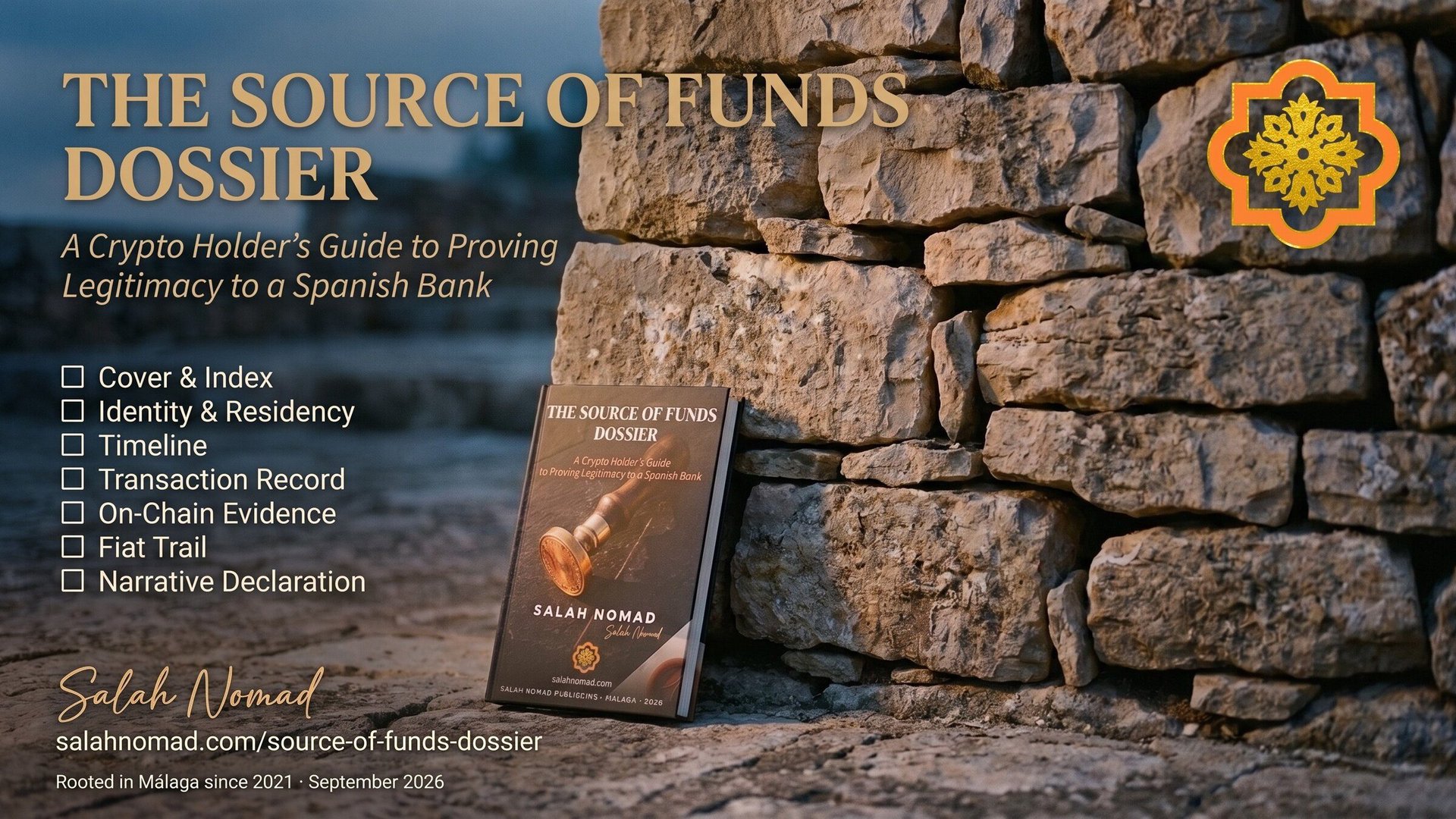
The Seven-Layer Framework — Cover, Identity, Timeline, Transaction Record, On-Chain Evidence, Fiat Trail, Narrative Declaration. Each layer answers a specific question the compliance officer is legally required to ask. The order is not arbitrary — it mirrors her reading sequence.
The Narrative Declaration — the only layer you write from scratch. Five paragraphs, ~300 words, every claim referenced to a specific document. The exact architecture that gets a file past the ninety-second first-pass decision.
The Five Scenarios — Long-Term Accumulator, Mixed Accumulator, DeFi Operator, Business-Origin Holder, Inheritor. Five profiles, five case files, five different emphases.
The Refusal Playbook — when the answer is no. Four refusal categories (policy, jurisdictional, documentation, suspicion), each with a distinct correct response. The three-rung escalation ladder. The reconstruction protocol. The alternative lender landscape.
The Bank Conversation — the ninety-second opening that sets the register. The three questions she must ask. The four objections and their correct answers. The 24-hour rule.
Appendix E — Anatomy of a Chain Analysis Report — what the compliance officer reads in seven seconds. Page-by-page breakdown of a real Chainalysis report, annotated.
📘 What’s Inside
Inside This Codex — 16 Chapters
The moment a banker asks where your money came from. Why crypto holders fail — and it is not honesty.
What the compliance officer actually does with your file. 45 minutes, hour by hour, from 08:47 to 09:32.
The seven layers. Cover, Identity, Timeline, Transaction Record, On-Chain Evidence, Fiat Trail, Narrative.
Long-Term Accumulator, Mixed Accumulator, DeFi Operator, Business-Origin Holder, Inheritor.
The five-paragraph architecture. The seven pitfalls. The bilingual attestation.
The first ninety seconds. The three questions. The four objections.
Four refusal categories. The escalation ladder. The reconstruction protocol.
The biographical companion document. Five sections.
Physical structure, folder architecture, backup discipline, retention period.
Every term a compliance officer uses, decoded.
Printable on one page.
Four documents, ready to adapt.
Chainalysis, Elliptic, TRM Labs, Crystal Blockchain.
Annotated page by page.
Do I need to own crypto to buy this guide?
Does this cover Spanish banks only?
How long does it take to assemble a dossier?
What is the difference between source of funds and source of wealth?
Do I need a lawyer to build this?
Is this the same as the December 31st Protocol?
The Source of Funds Dossier is the fourth book in the Rooted Nomad collection. 127 pages. First Edition, September 2026.
Updates logged at salahnomad.com/source-of-funds-dossier/updates/.

Comments