🌍 The Paradox of the Digital Ghost
I stood in a high‑rise apartment in Berlin, the glass walls offering a panoramic view of a city I didn’t yet know. My laptop was open, my Wi‑Fi was fast, but my soul felt thin, as if the constant movement had stretched my identity to the point of transparency.
This is the silent crisis of the modern nomad: we have location independence, but we suffer from soul‑deep disconnection. We are free from the office, but we haven’t yet learned to be free for belonging. In my early years of travel, I was a digital ghost—haunting beautiful cities but never truly inhabiting them.
The cure didn’t come from a new destination. It came from the Art of Being—the first law of Rooted Nomadism, which teaches that resilience grows from the inner world you carry with you. To thrive in motion, we must cultivate Portable Roots: practices that travel as light as a suitcase but weigh as much as an ancestral home.
⚓ The 5 Anchor Rituals: Sculpting Your Sanctuary
These rituals are not about interior design; they are about sensory reclamation. They take less than 15 minutes but signal to your nervous system that the “hunt” is over and the “harvest” has begun.
1. The Arrival: Sanctifying the Soil
In the Jbala mountains, my grandfather never entered a field without acknowledging the earth. He would kneel, touch the soil, and murmur a prayer of gratitude before beginning his work. When you enter a new space, don’t just drop your bags and collapse onto the nearest surface. Cleanse one surface.
- The Ritual: Wipe down a surface that will anchor your stay (desk or table) with a damp cloth. Add a drop of essential oil like rosemary or orange blossom.
- The Why: This simple act of manual labour claims the space through your senses. You are moving from a consumer of a digital “listing” to the steward of a physical “home.”
2. The Sacred Object: The Tactile Tether
We live in an age of pixels and glass. To feel rooted, we need texture—something that resists the digital tide with the weight of the physical world.
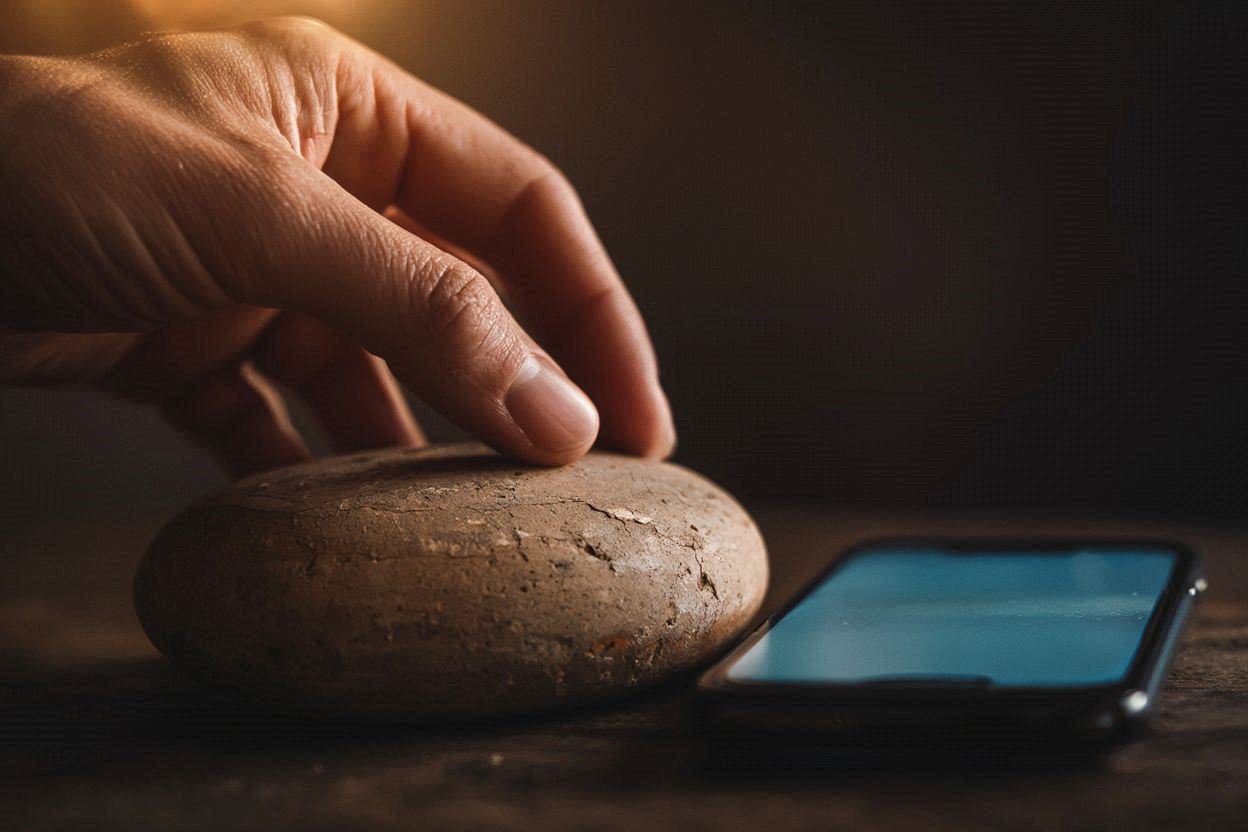
- The Ritual: Place one non‑digital object on your workspace. Choose something small enough to travel, meaningful enough to anchor.
- The Why: This is your “Anchor Stone.” Touching it grounds you in your own timeline amidst changing environments.
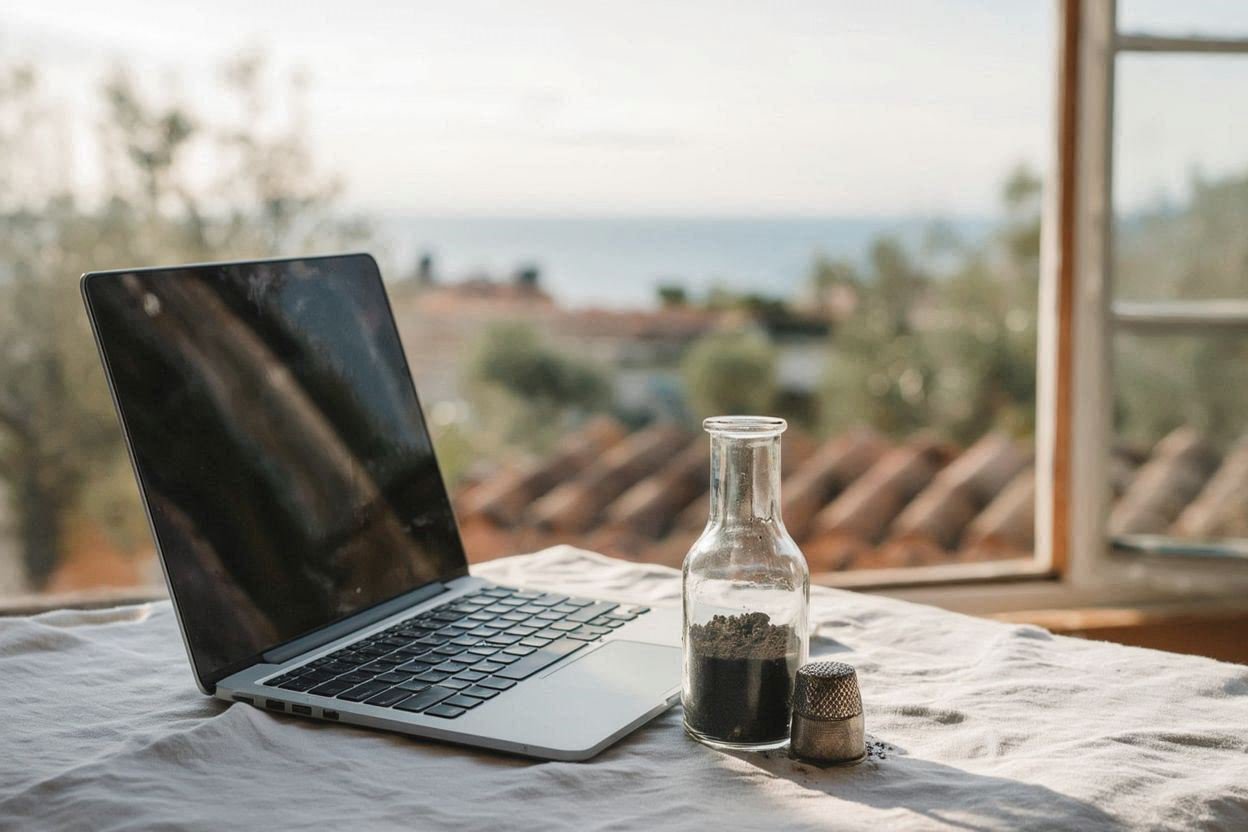
Choose your object by your need: Earth (a vial of soil, a stone) if you crave grounding; Craft (a thimble, a handmade item) if you identify as a creator; Memory (a photo, a letter) if you’re navigating loss or transition; Function (a specific pen, a notebook) if you’re pragmatically oriented. The category matters less than the intention you assign.
For me, the object is a small vial of Ksar El‑Kébir soil and my grandmother’s silver thimble.
3. The Tea: The Mediterranean Pulse
Time in the Mediterranean is qualitative, not just quantitative. We don’t ask “How long will it take?” but “How will it feel?”
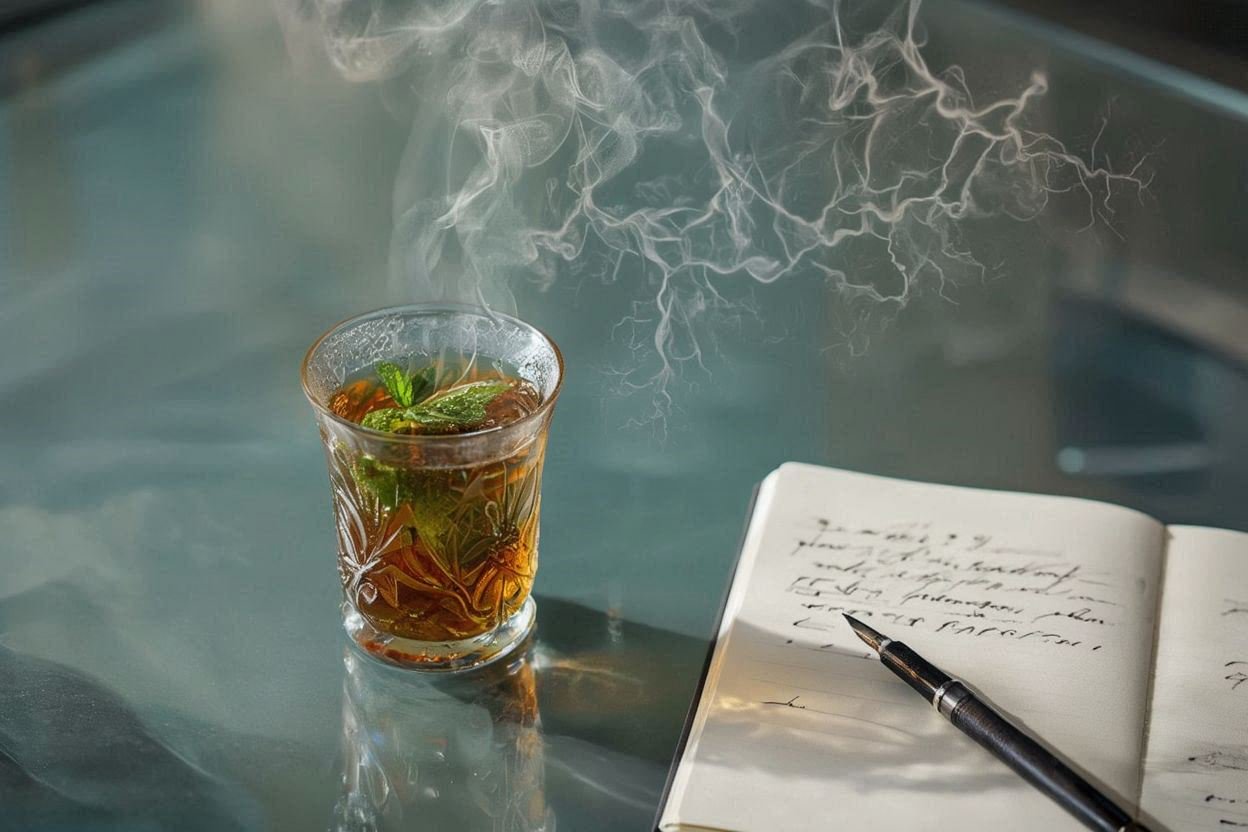
- The Ritual: Prepare a cup of tea with the same intentionality as a Zak’s Analog Tea Ceremony . Take three intentional sips before opening your laptop.
- The Why: You are downloading a slower pace into your nervous system, refusing to let the digital clock dictate your pulse.
Where the Olive Grove Digital Detox uses tea as an episodic reset for a burned‑out nervous system, this daily Tea Ritual is preventive—a morning anchor that ensures you never reach that point of saturation. The Detox cures; the Ritual prevents.
4. The Light: Sculpting the Ambiance
Sterile overhead lighting is the enemy of the Thermae Flow State . Walk into any Andalusian courtyard, and you’ll find light carefully modulated.

- The Ritual: Turn off the main overhead lights. Create a “pool of focus” using a small portable lamp or a candle.
- The Why: By controlling your visual environment, you define the boundaries of your world. You are in a Patio of Trust.
5. The Departure: The Ritual of Gratitude
A nomad should move not as an extractor, but as a “value migrant”—someone who enriches every ecosystem they touch.
- The Ritual: Before checking out, spend 2 minutes in silence. Leave a small, handwritten note or a specific digital “thank you” in the review.
- The Why: This closes the loop. It ensures you leave a Positive Wake behind you, rather than just a transaction.
Note: Studies from institutions like Stanford’s Digital Wellness Lab (2024) support these findings, though the exact percentage varies by individual context.
🏗️ Adaptation: Rituals Across Landscapes
The beauty of the Anchor Rituals is their modularity—like the Zellige Blueprint , they can be reassembled to fit your context.
- In a Busy Coliving: Focus on the Tea Ritual and Sacred Object to create an invisible psychological “Hammam.”
- In a Hotel Room: Focus on the Arrival and Light rituals to aggressively impose your own rhythm.
- In Transit (Trains, Planes, Airports): Use a “Micro‑Anchor.” Press your Sacred Object against your wrist for 10 seconds. Feel its texture, its temperature, its weight. This 10‑second communion maintains your inner continuum amidst the chaos of movement.
- In Nature (Camping, Retreats): Focus on Arrival and Departure—acknowledge the land, thank it when you leave.
🪞 Witnessing the Change: My Road to Resilience
In March 2020, when my world collapsed and I was forced into isolation in Morocco, I realized I had plenty of “wings” but no “roots.” My 15‑year business had evaporated overnight, and I found myself in our family olive grove, surrounded by trees that had survived droughts, plagues, and empires.
I began practicing these rituals—not because they were “productive,” but because they were necessary for survival. As I cleaned the dust off an old wooden table that had witnessed three generations of meals, I felt the static of the pandemic discharge into the earth. These rituals transformed my anxiety into the Jbala Resilience Quartet : I learned to channel the rain rather than fear the storm (Anezzar), to create within containers rather than chaos (Tagra), to anchor my days in a dawn practice (Aberoo), and to rest in the generative darkness (Asallas).
The Anchor Rituals didn’t save my business. They saved my sense of self.

🌟 Your Invitation to Stay Rooted
We don’t find home by searching maps; we recognise it when our rituals meet the land.
Tomorrow, I invite you to try just one: The Tea Anchor. Don’t check your email until the last sip is gone.
Ready to go deeper?
Join the “Mediterranean Insights” newsletter to receive the Anchor Rituals Checklist—a one‑page guide to carry these practices in your pocket.
Then pair them with the Art of Seeing to fully inhabit every stop on your journey. Where the Anchor Rituals ground you in a place, the Art of Seeing helps you truly see it.
❓ FAQ: Navigating the Art of Anchoring
What if I don't have a 'Sacred Object'?
Can I do these rituals in under 5 minutes?
Are these rituals useful for introverts?
How do I remember to do them when I'm tired or jet-lagged?
🔗 Weaving the Threads
The Anchor Rituals are one thread in the larger tapestry of Rooted Nomadism—the philosophy that teaches us to carry our roots as a compass, not a burden.
- If this resonated, explore next: The Art of Seeing to deepen your observation, or the Baker’s Code to channel this anchored presence into deep work.
The olive tree does not ask the wind where it comes from. It simply deepens its roots and offers its fruit. May your rituals be your roots, and your journeys be your fruit.
— Salah Nomad
Ksar El‑Kébir / Málaga

Comments