

Last verified against primary sources: 14 October 2026. Rates and bonifications change by regional law; confirm the figures for the year of death before filing.
I. The Asymmetric Loss and the Liquidity Gap
A bank account passes to heirs slowly but surely. A self-custodied crypto portfolio passes only if someone can prove it exists, prove it was the deceased’s, and reach the keys. If the keys are lost, the loss is not a percentage discount. It is total, and the tax authority still treats the asset as part of the estate.
The popular version of this story says heirs are trapped in a circular lockout: exchanges and banks freeze everything, the notary refuses to sign until the tax is paid, and the tax cannot be paid without selling the frozen assets. The mechanics are more nuanced, and the nuance matters for planning.
┌─ THE ACTUAL SEQUENCE (BANK ACCOUNTS AND CUSTODIAL BALANCES)
│
│ 1. Death            Tax accrues. Value is fixed at the date of death.
│ 2. Institution      Asks for: death certificate, Última Voluntad
│                     certificate, will or declaración de herederos.
│ 3. Heirs            Accept and partition the estate (public deed).
│                     No prior tax payment is needed to sign it.
│ 4. Tax              Modelo 650 filed and paid within six months.
│ 5. Release          Institution releases assets against the deed plus
│                     proof of payment or exemption. It is subsidiarily
│                     liable for the tax (Art. 8 Ley 29/1987).
│
│ SAFETY VALVE: heirs may ask the bank to pay the tax from the
│ deceased's own account via a cheque to the tax authority, and the bank
│ may withhold only that amount, not block the whole balance.
└─────────────────────────────────────────────────────────────────────
That sequence comes from the Bank of Spain’s customer portal and the tax agency’s own Modelo 650 documentation, which lists the acceptance deed among the attachments. The notary does not wait for the tax receipt before signing the deed.
Where the gap is real for crypto:
- Self-custody. No institution holds the assets. Without keys, there is nothing to release and nothing to pay the tax with.
- Custodians (CASPs). The Bank of Spain guidance covers credit institutions. Whether a given exchange will pay the tax from the deceased’s balance, or how fast it processes a succession claim, is a matter of its own procedure. Treat it as unconfirmed until the provider confirms in writing.
- Price risk. The tax is fixed on the date-of-death value. A later crash does not reduce it.
- Currency mismatch. The tax is payable in euros; the estate is in crypto.
Crash case (Catalonia, adult child, no other reliefs). A portfolio worth €1,000,000 at death produces about €103,000 of tax (calculation in Section III). If the market then falls 65% before the heirs can sell, the portfolio is worth €350,000 and the tax is still about €103,000, which is 29% of what is left.
II. The Six-Month Clock: Modelo 650, Extensions and Penalties
The deadline comes from Article 67 of the Inheritance Tax Regulation (Real Decreto 1629/1991). The extension comes from Article 68.
┌─ THE MODELO 650 TIMELINE
│
│ Day 0        Accrual (devengo). Valuation date for every asset.
│ Month 1-3    Identify heirs, obtain NIEs, inventory assets, gather proof.
│ By month 5   LAST DAY to request the six-month extension.
│ Month 6      Standard deadline to file and pay.
│ Month 7-12   If the extension was granted: file by month 12, with
│              late-payment interest running from month six.
└──────────────────────────────────────────────────────────────────
- Extension (Art. 68 RISD). One six-month extension, requested within the first five months. A request after month five is refused. If granted, it starts after month six and carries late-payment interest until you file.
- Late filing without an extension. Under Article 27 of the General Tax Law (LGT), a voluntary late filing carries a surcharge of 1% plus 1% for each full month of delay, up to twelve months, and 15% plus interest beyond that. Penalties apply if the authority finds the omission first.
- Where you file. The tax is ceded to the regions, so you normally file with the regional authority of the deceased’s last habitual residence. Some regions also require a companion form: in Andalusia, for example, a single Modelo 660 accompanies one Modelo 650 per heir.
- Even at zero tax, you must file. A 99% bonification does not remove the filing duty, and the receipt is what banks and registries ask for.
- Heirs need a Spanish tax ID. The AEAT documentation list asks for a copy of each heir’s NIF. Non-resident heirs should start the NIE process in month one, because availability of appointments varies and cannot be forced.
III. The Regional Matrix: Andalusia, Madrid, Valencia, Catalonia
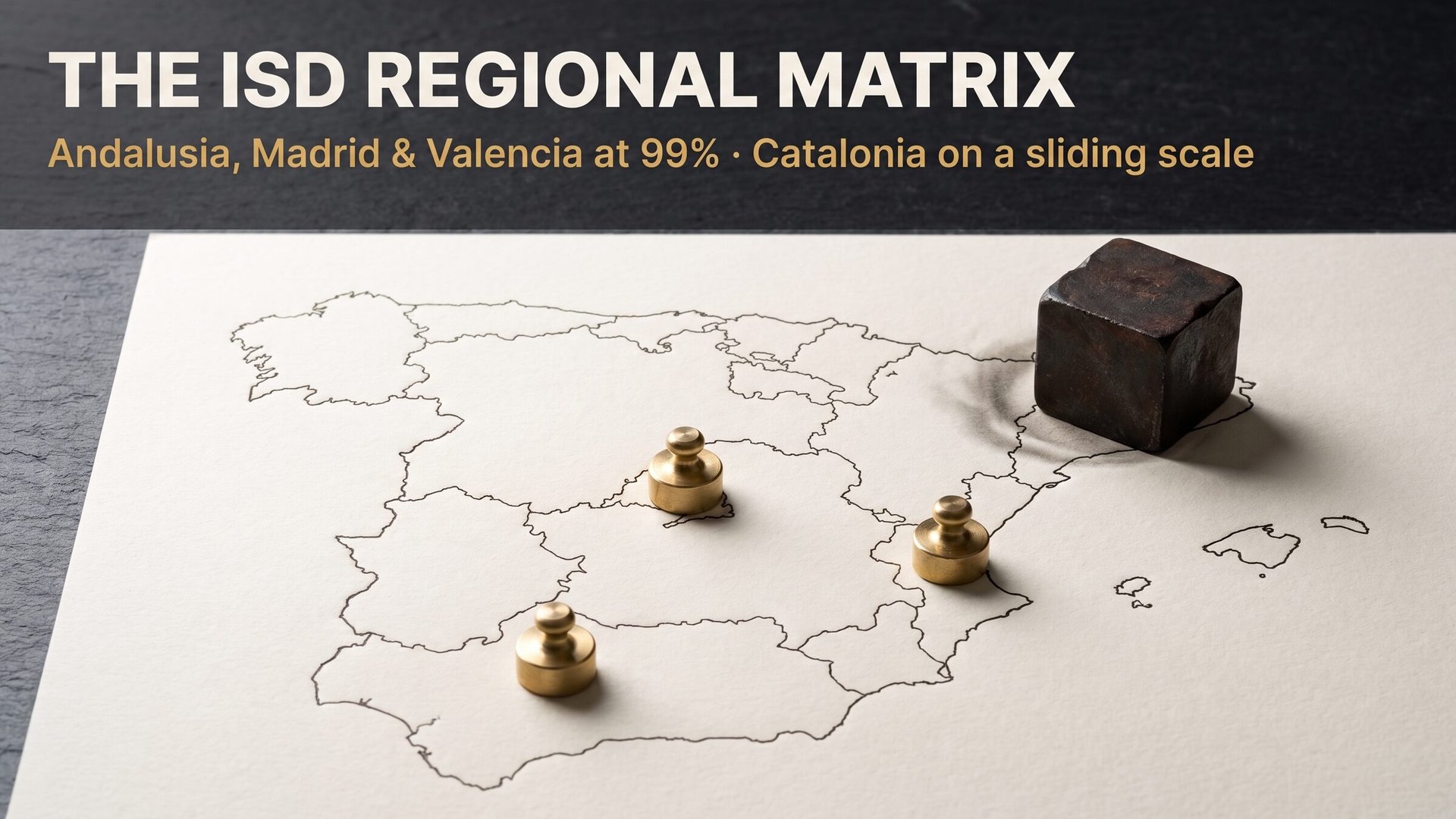
Spain has no single inheritance tax rate. Which region applies is decided by where the deceased lived longest during the five years before death (Article 32, Ley 22/2009), not by where the heir lives or where the assets sit. Heirs cannot choose.
| Region | Spouse, children, parents (Groups I-II) | Points to check |
|---|---|---|
| Andalusia | €1,000,000 reduction per heir, then 99% bonification of the tax (Ley 5/2021) | Own tariff of 7% to 26% |
| Madrid | 99% bonification of the tax | State tariff; Group III siblings get 50% from 1 July 2025 |
| Valencia | €100,000 reduction, then 99% bonification (Ley 6/2023) | Group III bonification of 25% from June 2026, reported rising to 50% in June 2027 |
| Catalonia | Spouse or stable partner: 99%. Adult children and parents: sliding bonification from 60% to 0% by estate tranche | Own tariff of 7% to 32%; €100,000 reduction for an adult child |
| Balearics | Reported 100% for direct heirs | Verify against the current regional law before relying on it |
Worked example: €2,000,000 in crypto to one adult child
Assumptions: the deceased lived in the region for five years; the heir’s pre-existing wealth is below the first coefficient threshold (multiplier 1.00); no real estate, no life insurance, no prior gifts; the statutory household-goods presumption (ajuar) is ignored.
| Region | Reduction | Taxable base | Gross tax | Bonification | Tax payable |
|---|---|---|---|---|---|
| Andalusia | €1,000,000 | €1,000,000 | €223,620 | 99% | about €2,236 |
| Madrid | about €16,000 | about €1,984,000 | €602,697 | 99% | about €6,027 |
| Catalonia | €100,000 | €1,900,000 | €505,000 | 35.88% (weighted) | about €323,800 |
How the Catalan figure is built: the tariff gives €153,000 plus 32% of the €1,100,000 above €800,000, which is €505,000. For an adult child the bonification is a weighted average across tranches of the pre-reduction base, running 60%, 55%, 50%, 45%, 40%, 35% up to €1M, then 30%, 25%, 20% and 10% in the higher tranches, and 0% above €3M. At €2M the average is 35.88%, so the heir pays 64.12% of €505,000. The Catalan tax agency’s own worked example confirms the method: at €1.3M it computes 40.96% on exactly this basis.
The gap between the cheapest and the dearest region for the same portfolio and the same heir is about 145 times. Catalonia’s relief also halves if the heir opts for certain other reductions, and its multiplier rises with the heir’s own wealth (1.10 above €500,000, 1.15 above €2M, 1.20 above €4M). These are modelling inputs, not footnotes, so run the numbers with a regional adviser before any residency decision.
A word on political risk. In 2025 the central government floated a harmonisation of Inheritance Tax across the regions. In the sources reviewed for this article, no reform that removes regional bonifications had been enacted as of October 2026. Treat today’s matrix as current law, not a guarantee.
IV. Valuation at Death and the Cost-Basis Reset
The Modelo 650 instructions require the real value of each asset at the date of death. There is no official crypto price table in those instructions, so the defensible approach is documentary: fix a method, apply it consistently, and keep the evidence.
Practical valuation file:
- The price source for each asset (the principal exchange where it was held, or a volume-weighted average across named venues) at the date and time of death.
- A timestamped capture of that price, plus the heir’s calculation.
- For illiquid or unlisted tokens, an independent valuation report.
The step-up. For an ordinary inheritance the heir’s acquisition value is the value used for Inheritance Tax, capped at market value (Article 36 LIRPF), and the deceased’s latent capital gain is exempt (Article 33.3.b LIRPF). Gains accrued during the deceased’s lifetime are never taxed. Only appreciation after death is taxed when the heir sells. The exception in the second paragraph of Article 36, introduced in 2021 and upheld by the Constitutional Court in 2023, targets succession contracts (pactos sucesorios) with present effect and a sale within five years. It does not apply to a standard will.
The donation trap. Gifting crypto during life is a transmission. The donor realises the gain and pays income tax on the savings scale (19% to 30%), while the donee’s basis resets to the value declared for gift tax. Death erases the gain; a gift crystallises it. And if the donor dies, gifts made to that heir in the four years before death are added back into the estate base (see the Modelo 650 instructions). Gifts can still make sense in bonifying regions, but only after you model the donor’s gain.
V. Cross-Border Succession: EU Regulation 650/2012 and Professio Juris
For foreigners living in Spain, the question is which country’s succession law applies. Under the Regulation:
- Default (Art. 21): the law of the State of the deceased’s habitual residence at death. For a resident of Spain, that is Spanish law.
- Choice (Art. 22): a person may choose the law of the State whose nationality they hold, at the time of choosing or at death.
- Scope (Art. 23): the chosen law governs the succession as a whole, not just movable assets.
- Universal application (Art. 20): the law designated applies whether or not it is a Member State’s. The Regulation does not bind Denmark or Ireland.
┌─ DEFAULT vs. ELECTED LAW
│
│ DEFAULT   Spanish law governs. Under the Código Civil (arts. 806-822),
│           two thirds of the estate is reserved to children (legítimas).
│           In Catalonia, a separate civil code reserves one quarter.
│
│ ELECTED   A clause in the will chooses the law of nationality (e.g.
│           English law). Forced heirship under Spanish law no longer
│           governs, and the testator has freedom of disposition under
│           the chosen law.
│
│ NOT CHANGED  The tax. ISD is still assessed under Spanish and regional
│              rules, because the Regulation excludes tax matters.
└────────────────────────────────────────────────────────────────────
Implementation notes.
- Put the election in a will executed before a Spanish notary, and make sure the clause expressly refers to the chosen law.
- Nationals of countries with several territorial laws (the United States, the United Kingdom) should confirm with counsel which territorial law the clause designates.
- The European Certificate of Succession (Articles 62-73) lets an heir prove their status in other Member States. In Spain it is issued through a notary. It is useful when the custodian is an EU-authorised provider outside Spain.
- Keep wills consistent. A Spanish will and a foreign will that contradict each other is the most common cause of a stalled estate.

VI. The Proof Problem: On-Chain Ownership
A notary or tax office cannot inspect a blockchain and conclude that an address belonged to a particular person. Heirs need evidence that links the deceased to the wallet, and proof that the heirs now control it.
┌─ EVIDENCE HIERARCHY FOR SELF-CUSTODIED CRYPTO
│
│ TIER 1  Pre-mortem notarial acta (acta de manifestaciones): the owner
│         declares the public addresses before a notary. Strongest
│         evidence, though no statute requires it.
│
│ TIER 2  Records outside the chain: exchange statements and KYC for the
│         fiat on-ramp, bank transfers, and tax returns declaring the
│         related gains or holdings.
│
│ TIER 3  Post-mortem forensics: a chain-analysis report tracing the
│         fiat on-ramp to the wallet, plus a message signed with the
│         wallet's key to show current control.
└───────────────────────────────────────────────────────────────────
Three corrections to common advice.
- Modelo 721 is not an address registry. It reports balances held with foreign custodians, not self-custody. Do not count on it as proof of wallet ownership. See our Modelo 721 guide for what it does cover.
- A signed message proves control, not identity. It shows that whoever holds the key can sign. Identity still has to come from KYC records or the notarial acta.
- Never put a seed phrase or private key in a notarial document. List public addresses only. Extended public keys (xpubs) reveal the entire transaction history, so use them only where a documented need outweighs the privacy cost.
VII. The Five Pre-Mortem Tactics
- Size a euro reserve to your own region, not to a rule of thumb. Use the model in Section III: the reserve for the same €2M portfolio is about 0.1% of the estate in Andalusia, about 0.3% in Madrid and about 16% in Catalonia, before notary, registry and municipal costs. Hold it where the heirs can reach it quickly. Options include a life insurance policy with named beneficiaries (treated as an inheritance for tax purposes, with regional rules) and the Bank of Spain payment-from-estate route for bank balances.
- Execute a notarial acta of public addresses (Section VI), and store the seed backups with a documented, legally sound access plan.
- Write a Spanish will with a professio juris clause if you are a foreign national and want to avoid Spanish forced heirship, with consistent wills in every country where you own assets.
- Model lifetime gifts before making them. They crystallise the donor’s gain (Section IV) and are added back if death occurs within four years. They can still win in bonifying regions, but never by default.
- Do not assume a company wrapper solves anything. Putting crypto in a Spanish Sociedad Limitada does not remove the access problem, because someone still holds the keys, and the 95% family-business reduction requires a real economic activity, not passive holding of assets. A crypto treasury usually fails that test. If you consider moving a company abroad later, see our guide to the corporate exit tax on crypto treasuries.
VIII. Heirs’ Checklist by Month
| When | Action |
|---|---|
| Day 0-30 | Obtain the death certificate, the Última Voluntad certificate and the will. Capture date-of-death prices. Notify custodians in writing and ask for their succession procedure. |
| Month 1-2 | Start NIE applications for non-resident heirs. Inventory every wallet, exchange and DeFi position. Locate seed backups through the documented access plan. |
| Month 2-4 | Sign the deed of acceptance and partition. Ask each bank to issue the tax-payment cheque from the deceased’s account. |
| By month 5 | If anything is missing, request the extension. After month five it is refused. |
| Month 6 | File and pay Modelo 650 (plus any regional companion form). File even if the tax is zero. |
| After | Keep the Modelo 650 receipt and the valuation file. The declared value becomes the heirs’ cost basis for later sales. See our bank AML guide before moving inherited crypto to fiat. |
IX. Field Manuals and System Integration
To execute these protocols with procedural templates and the full regional matrix, use the specialised manuals in the Rooted Nomad collection:
Reads Well With
❓ Frequently Asked Questions
¿Cómo tributan las criptomonedas heredadas en España?
Can heirs pay the Spanish inheritance tax out of the deceased's bank account?
¿Qué bonificaciones existen para la herencia crypto en Madrid, Andalucía y Cataluña?
Can a foreign resident elect their national law to govern a Spanish crypto inheritance?
Does inheriting crypto reset the cost basis for income tax?
How do I extend the Modelo 650 deadline?
How do heirs prove ownership of self-custodied crypto?
Sources and Verification
Primary and official sources consulted on 14 October 2026:
- Bank of Spain, customer portal: payment of the tax from the deceased’s account, and the documents required to release assets.
- Agencia Tributaria, Modelo 650: filing instructions, attachments and the four-year gift add-back.
- Real Decreto 1629/1991, Articles 67-68 (deadline and extension), as published by the regional tax offices of Madrid, Andalusia, Catalonia and La Rioja.
- Agència Tributària de Catalunya: tariff, coefficients, reductions and the weighted-average bonification with worked examples.
- Junta de Andalucía and Ley 5/2021: reduction of €1,000,000, 99% bonification and the own tariff.
- Comunidad de Madrid (Decreto Legislativo 1/2010, Ley 2/2025) and Generalitat Valenciana (Ley 6/2023, Ley 5/2025).
- Agencia Tributaria personal income tax manual and Constitutional Court ruling STC 62/2023: acquisition value on inheritance and the pactos sucesorios exception.
- Regulation (EU) No 650/2012, Articles 20-23 and 62-73.
Disclaimer: This document is an operational field guide detailing succession mechanics and tax protocols under Spanish and EU law. It does not constitute legal advice, estate planning representation or tax advisory services. Regional rates change; verify all provisions in the official gazettes (BOE and regional bulletins) and consult a qualified Spanish abogado and notario before executing legal instruments.



Comments