


I. The Perimeter Split: Art. 19 LIS vs. Art. 95 bis LIRPF
A critical tax misunderstanding exists among founders and Chief Financial Officers operating Spanish corporate structures (Sociedades Limitadas): believing that personal exit tax rules apply to corporate treasuries.
On April 14, 2025, the Dirección General de Tributos (DGT) issued binding ruling V0666-25, establishing that conventional cryptocurrencies are legally classified as bienes inmateriales (intangible property) and are therefore excluded from the personal exit tax under Article 95 bis of the LIRPF. Because Article 95 bis LIRPF explicitly targets acciones o participaciones en entidades (shares in companies), individual taxpayers moving their residence out of Spain do not pay personal exit tax on direct cryptocurrency holdings. The ruling confirms that no latent capital gain on crypto-assets is imputed by the mere fact of a change of residence for an individual.
This exclusion does NOT apply to corporate taxpayers.
┌─────────────────────────────────────────────────────────────────────────────┐
│                 THE PERIMETER SPLIT: PERSONAL VS. CORPORATE                 │
├─────────────────────────────────────────────────────────────────────────────┤
│ FEATURE              │ PERSONAL (ART. 95 BIS LIRPF) │ CORPORATE (ART. 19 LIS)│
├──────────────────────┼──────────────────────────────┼───────────────────────┤
│ Taxpayer             │ Resident Individual          │ Spanish SL / SA       │
│ Minimum Residence    │ 10 of preceding 15 years     │ None (Immediate)      │
│ Minimum Threshold    │ €4,000,000 / €1,000,000      │ NONE (€0 Threshold)   │
│ Crypto Assets        │ EXCLUDED (DGT V0666-25)      │ INCLUDED (100% Base)  │
│ Applicable Rate      │ 19% – 30% Savings Scale      │ Corporate Tax Rate    │
│ EU/EEA Installment   │ 10 Years Automatic           │ 5 Annual Fractions    │
│                      │                              │ (Interest de démora)  │
└──────────────────────┴──────────────────────────────┴───────────────────────┘
When a corporate entity subject to Spanish Corporate Income Tax (Impuesto sobre Sociedades - IS) transfers its residence or assets out of the Spanish fiscal perimeter, Article 19 of Ley 27/2014 (LIS) applies. Article 19 LIS—which transposed Article 5 of the EU Anti-Tax Avoidance Directive (ATAD, Directive EU 2016/1164)—covers all corporate assets without exception.
If a Spanish SL holds a corporate crypto treasury of €2,000,000 acquired for €200,000 and decides to relocate its effective management to Luxembourg, the AEAT treats the move as an arm’s-length sale at market value. The €1,800,000 latent gain is added to the SL’s taxable base in the year of transfer, generating an immediate corporate tax bill of €450,000 (25% of €1,800,000).
Rate note for SMEs: For micro-enterprises with turnover under €1,000,000, the first €50,000 of taxable income is taxed at 23% in 2026 (not 25%). The remainder and the general corporate rate remain at 25%. A small SL with a €2,000,000 crypto treasury would therefore pay slightly less than the flat 25% calculation on the first €50,000 of the exit base.

II. Anatomy of the 5 Corporate Trigger Events
Article 19.1 of the LIS defines five specific operational events that trigger the corporate exit tax assessment. Each event represents a scenario where assets or management leave the Spanish tax network without an immediate, equivalent Spanish permanent establishment (Establecimiento Permanente - EP) maintaining tax jurisdiction.
┌─────────────────────────────────────────────────────────────────────────────┐
│                  THE 5 ARTICLE 19 LIS CORPORATE TRIGGER EVENTS              │
├─────────────────────────────────────────────────────────────────────────────┤
│ EVENT 1 : Transfer of Tax Residence / Effective Management Abroad           │
│ EVENT 2 : Transfer of Corporate Assets to a Foreign EP / Subsidiary         │
│ EVENT 3 : Cessation of a Spanish Permanent Establishment (EP)               │
│ EVENT 4 : Cross-Border Merger resulting in Loss of Spanish Residence        │
│ EVENT 5 : Corporate Liquidation with Distribution of Assets to Foreign Heirs│
└─────────────────────────────────────────────────────────────────────────────┘
- Event 1 — Transfer of Effective Management (Traslado de Residencia): The SL maintains its legal incorporation in Spain, but its board of directors, strategic decision-making, and treasury operations relocate abroad. Under Spanish tax law, effective management determines residency.
- Event 2 — Transfer of Assets to a Foreign EP or Subsidiary: A Spanish SL contributes or transfers its crypto treasury, intellectual property, or operating assets to a foreign branch or subsidiary without maintaining a Spanish EP to which those assets remain attributable.
- Event 3 — Cessation of a Spanish EP: A foreign entity operating in Spain through a registered EP terminates its Spanish operations and transfers the accumulated Spanish assets back to the parent or a third jurisdiction.
- Event 4 — Non-Neutral Cross-Border Merger: A Spanish SL merges into a foreign absorbing entity and fails to meet the valid economic reasons test under the Spanish tax-neutral regime (Arts. 76–89 LIS).
- Event 5 — Liquidation and Cross-Border Asset Distribution: An SL liquidates its corporate balance sheet and distributes its crypto treasury directly to non-resident shareholders.
The Two Statutory Exclusions
Two specific scenarios do not trigger an Article 19 LIS assessment:
- The Spanish Permanent Establishment Exclusion: Assets physically or legally transferred to a foreign branch remain exempt from exit tax if they are formally attributed back to a continuing Spanish EP.
- The Temporary Transfer Exemption (Cesión Temporaire): Under Article 19.1 LIS, assets temporarily moved out of Spain that return to the Spanish fiscal perimeter within 12 months and remain assigned to a Spanish EP do not trigger tax. This clause accommodates short-term liquidity management, not permanent corporate relocations.

III. Latent Gain Calculation & Crypto Treasury Valuation
The corporate exit tax base is calculated as the difference between the market value of the transferred assets on the date of transfer and their fiscal value (tax basis) in the company’s accounting records.
Taxable Exit Base = Market Value (Art. 18 LIS) − Fiscal Value (FIFO Cost)
1. Market Value Standards (Art. 18 LIS)
Under Article 18.1 LIS, market value is defined as the arm’s-length price agreed between independent parties. For digital assets, the AEAT accepts closing spot rates published by CNMV-registered Crypto-Asset Service Providers (CASPs) or major public price aggregators (CoinGecko, CoinMarketCap) at 23:59 CET on the transfer date.
2. Fiscal Value and the Corporate FIFO Rule
The fiscal value corresponds to the historical acquisition cost documented in the SL’s general ledger (Plan General Contable). When an SL has accumulated crypto positions across multiple fiscal years, the First-In, First-Out (FIFO) matching rule mandated by Article 37.2 LIRPF applies by analogy to determine which corporate lots were transferred.
Worked Valuation Example: Corporate Crypto Treasury
Consider a Spanish software SL relocating its effective management to Ireland on June 30, 2026.
| Asset | Fiscal Value | Market Value (30/06/2026) | Latent Gain |
|---|---|---|---|
| Bitcoin (BTC) — 18 units @ €11,111 | €200,000 | €919,548 | +€719,548 |
| Ethereum (ETH) — 400 units @ €500 | €200,000 | €557,600 | +€357,600 |
| USD Coin (USDC) — 600,000 @ €1.00 | €600,000 | €600,000 | €0 |
| TOTAL | €1,000,000 | €2,077,148 | +€1,077,148 |
Spot prices per Coinbase BTC/EUR and CoinMarketCap ETH/EUR closing rates on 30 June 2026. ⚠️ Vérification manuelle requise avant publication — contrôler ces deux prix via CoinGecko historique ou l’API Coinbase le jour du commit final.
Corporate tax assessment (25% IS): €1,077,148 × 0.25 = €269,287
Stablecoins & Yield-Bearing Tokens
- Standard Stablecoins (USDC, EURC): Classified as bienes inmateriales (DGT V1149-18). If acquired at par (€1.00) and transferred at par, the latent gain is zero.
- Yield-Bearing Tokens (aUSDC, cUSDC, stETH): Tokens representing staked assets or liquidity pool positions accrue yield that increases their market value relative to the underlying. The latent gain calculation applies to the full token market value on the transfer date.
IV. Pre-Trigger Restructuring: The Neutral Regime & Interval Risk
Executing a corporate exit without prior structural planning guarantees an immediate corporate tax bill. To mitigate this exposure, sophisticated structures utilize the Spanish Tax-Neutral Restructuring Regime under Articles 76 to 89 of the LIS (transposing EU Merger Directive 2009/133/EC).
The Two-Stage Contribution-Cessation Protocol (Aportación No Dineraria)
Instead of transferring the SL directly, the founders execute a two-stage restructuring:
┌─────────────────────────────────────────────────────────────────────────────┐
│                 THE TWO-STAGE NEUTRAL RESTRUCTURING TIMELINE                │
├─────────────────────────────────────────────────────────────────────────────┤
│ STAGE 1 (Month 0)  : SL contributes Crypto Treasury to EU Holding (Art. 76) │
│                      ──► Tax-neutral transfer at fiscal book value          │
│                                                                             │
│ [RECOMMENDED INTERVAL : Operational & Substance Build-Out Period]           │
│                                                                             │
│ STAGE 2 (Month 18+) : SL transfers Effective Management or absorbs into EU  │
│                      ──► Art. 19 Exit Tax applies ONLY to residual SL assets│
└─────────────────────────────────────────────────────────────────────────────┘
- Stage 1 — Non-Monetary Contribution (Aportación No Dineraria): The Spanish SL contributes its crypto treasury to a newly established EU holding company (e.g., a Luxembourg SOPARFI or Dutch BV) in exchange for 100% of the holding’s equity. Under Articles 76–89 LIS, this transaction occurs at fiscal book value without triggering capital gains tax.
- Stage 2 — Management Transfer or Absorption: At a later date, the Spanish SL transfers its effective management or absorbs into the EU holding. Article 19 LIS applies exit tax only to the residual assets remaining inside the Spanish SL at the moment of Stage 2.

The Interval Risk: Substance Over Stopwatch
The AEAT examines two-stage restructurings under the abuse-of-law doctrine (conflicto en la aplicación de la norma, Art. 15 LGT). No statute prescribes a fixed minimum interval between Stage 1 and Stage 2. The 12-month reference in Article 19.1 LIS concerns the cesión temporaire exemption (assets temporarily transferred abroad), not neutral restructuring timelines.
What reduces audit risk:
- A documented business rationale for each stage (market expansion, EU capital access, operational centralisation)
- Substance build-out in the destination jurisdiction (office lease, local directors, payroll)
- An interval long enough to demonstrate operational independence — practitioners commonly cite 12 to 18 months as a defensible minimum, but this is practice, not statute
The 4-Element Substance Test
To defend the neutral regime during an AEAT audit, the foreign holding must satisfy four core substance requirements:
- Valid Economic Rationale: Demonstrating business expansion, access to European capital markets, or operational centralization (tax-rate arbitrage alone is explicitly rejected).
- Physical Infrastructure & Personnel: Local office lease, resident directors, and real decision-making capacity in the destination country.
- Temporal Depth: Maintaining the new structure without immediate liquidation or reversal.
- Contemporaneous Documentation: Board minutes, business plans, and independent valuation reports dated prior to execution.
V. EU Installment Mechanics vs. Third Countries (Art. 19.1 LIS)
When an Article 19 LIS exit tax is assessed, the payment schedule depends on whether the destination jurisdiction belongs to the European Union (EU) or the European Economic Area (EEA).
┌─────────────────────────────────────────────────────────────────────────────┐
│                     ARTICLE 19.1 LIS INSTALLMENT MECHANICS                  │
├─────────────────────────────────────────────────────────────────────────────┤
│ EU / EEA DESTINATIONS (Luxembourg, Netherlands, Portugal, Ireland)          │
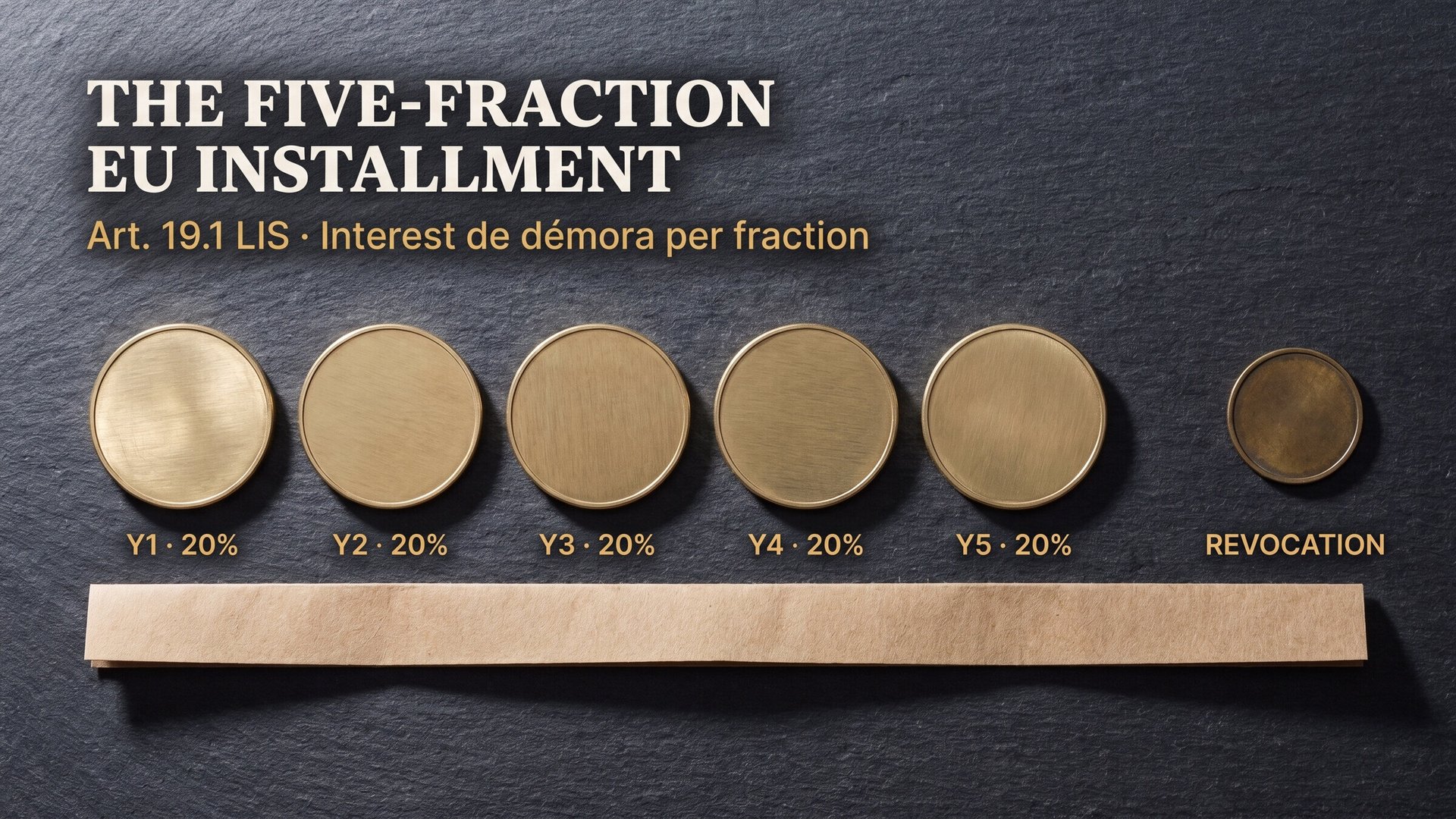
│  ✓ 5 Equal Annual Fractions (20% per year over 5 years)                     │
│  ✓ Interest de démora accrues on each deferred fraction (LGT rate)          │
│  ✓ Guarantees may be required if collection risk is evidenced               │
│                                                                             │
│ THIRD COUNTRIES (Switzerland, United Arab Emirates, United States)         │
│  ✗ NO Statutory Installment Available                                       │
│  ✗ 100% Exit Tax Bill due in full in Year 1                                 │
│  ✗ Immediate payment may require asset liquidation if cash is insufficient  │
└─────────────────────────────────────────────────────────────────────────────┘
1. The 5-Fraction EU/EEA Installment Plan (Art. 19.1 LIS)
For corporate transfers to an EU or EEA member state with a mutual assistance agreement equivalent to Directive 2010/24/EU, Article 19.1 LIS grants the right to split payment over five equal annual fractions (20% per year). The option is exercised in the corporate tax return (Modelo 200, casilla 01572 and related) for the period in which the change of residence occurs.
Critical correction to widespread misinformation: The installment plan is not interest-free. The four deferred fractions accrue interest de démora under the Ley General Tributaria at the statutory rate in force. The AEAT’s Practical Manual confirms: “El vencimiento y exigibilidad de las cuatro fracciones anuales restantes, se exigirán junto con los intereses de demora devengados por cada una de ellas.” For 2026, the interest de démora rate is approximately 4,0625 %.
For a €500,000 exit tax assessment, the SL pays €100,000 in year 1, then €100,000 + accrued interest for each of the four subsequent years.
2. Revocation Triggers
The installment plan is immediately revoked if any of the following events occur during the 5-year window:
- The transferred assets are subsequently transferred to a third country outside the EU/EEA.
- The company relocates its tax residence out of the EU/EEA.
- The company enters corporate liquidation or bankruptcy proceedings.
Upon revocation, all remaining unpaid fractions become instantly due, along with statutory delay interest (intereses de demora) calculated from the original filing date.
VI. Destination Jurisdiction Comparison Matrix
Selecting a destination jurisdiction requires balancing Corporate Income Tax (CIT) rates against EU installment availability, treaty protection, and AEAT audit risk.
Fiscal and EU Position
| Jurisdiction | Standard CIT | EU / EEA | Art. 19.1 Installment |
|---|---|---|---|
| Spain (baseline) | 25% | Yes | N/A |
| Luxembourg | 24.94% | Yes | 5 fractions |
| Netherlands | 25.8% | Yes | 5 fractions |
| Portugal | 21% | Yes | 5 fractions |
| Switzerland | 12% – 21% | No | None (100% Year 1) |
| United Arab Emirates | 0% / 9% | No | None (100% Year 1) |
Treaty, Substance, and Audit Risk
| Jurisdiction | DTT with Spain | Substance Standard | AEAT Audit Risk |
|---|---|---|---|
| Spain (baseline) | N/A | N/A | N/A |
| Luxembourg | Yes | High | Moderate |
| Netherlands | Yes | High | Moderate |
| Portugal | Yes | Medium | Elevated |
| Switzerland | Yes | Medium | High |
| United Arab Emirates | Yes (2006 DTT) | High scrutiny | Extreme |
Reading the Matrix
- Luxembourg & Netherlands: Ideal for corporate holdings (SOPARFI / BV) utilizing the participation exemption. Qualify for the 5-fraction installment, but require robust physical substance.
- Portugal: Lower CIT rate (21%) and qualifying EU status. High AEAT scrutiny regarding “paper substance” relocations from neighboring Spain.
- Switzerland: Lower CIT rates (12%–21%), but no statutory installment. The full exit tax on latent gains must be paid immediately in Year 1.
- United Arab Emirates: 0%–9% CIT. A double tax treaty with Spain exists (signed 5 March 2006, BOE-A-2007-19465). However, the UAE does not qualify for the Article 19.1 LIS installment plan (not EU/EEA). The full exit tax is due in Year 1. The combination of no installment, high AEAT scrutiny, and substance challenges makes this the highest-risk destination for a Spanish SL exit.
VII. Post-Exit Compliance & The 4-Year Shadow Window
Completing a corporate relocation does not instantly sever ties with the Spanish tax authority. Under Article 66 of the Ley General Tributaria (LGT), the AEAT retains a 4-year statute of limitations to audit the transaction.
┌─────────────────────────────────────────────────────────────────────────────┐
│                     THE 4-YEAR SHADOW RESIDENCY AUDIT WINDOW                │
├─────────────────────────────────────────────────────────────────────────────┤
│ YEAR 1 : Exit declared on Modelo 200 (boxes 01572, 01573, 00037 if split)  │
│ YEAR 2 : First annual installment paid with interest de démora              │
│ YEAR 3 : Mid-window AEAT cross-match against DAC8 corporate data streams    │
│ YEAR 4 : Final audit window expiration (Art. 66 LGT)                        │
└─────────────────────────────────────────────────────────────────────────────┘
The 4 Audit Triggers in the AEAT 2026 Control Plan
The Plan Anual de Control Tributario y Aduanero prioritizes corporate exits featuring:
- Short Pre-Sale Windows: Restructurings executed within 24 months prior to a corporate sale or M&A event.
- Paper-Only Substance: Foreign entities lacking physical office leases or local payroll entries.
- Intangible-Heavy Balance Sheets: Balance sheets dominated by cryptocurrencies, software, or IP rather than physical plant equipment.
- Declarative Discrepancies: Inconsistencies between corporate filings (Modelo 200), informational declarations (Modelo 720/721), and CASP data reported under DAC8.
VIII. Field Manuals & System Integration
To execute a corporate exit or restructuring without triggering unmanaged liabilities, leverage the specialized manuals in the Rooted Nomad collection:
Reads Well With
❓ Frequently Asked Questions
¿Aplica la Exit Tax a una Sociedad Limitada (SL) con tesorería en criptomonedas?
Does the crypto exclusion in DGT V0666-25 apply to Spanish SLs?
¿Existe un umbral mínimo de plusvalía para la Exit Tax corporativa?
Can the corporate exit tax bill be deferred?
What breaks the Article 19.1 LIS EU installment plan?
How does a two-stage pre-exit restructuring work?
Disclaimer: This document is an operational field guide detailing corporate tax mechanics under Spanish and EU law. It does not constitute formal legal, tax, or corporate restructuring advice. Verify all statutory provisions in the Boletín Oficial del Estado (BOE) and consult a licensed abogado tributarista prior to executing corporate restructurings.




Comments