

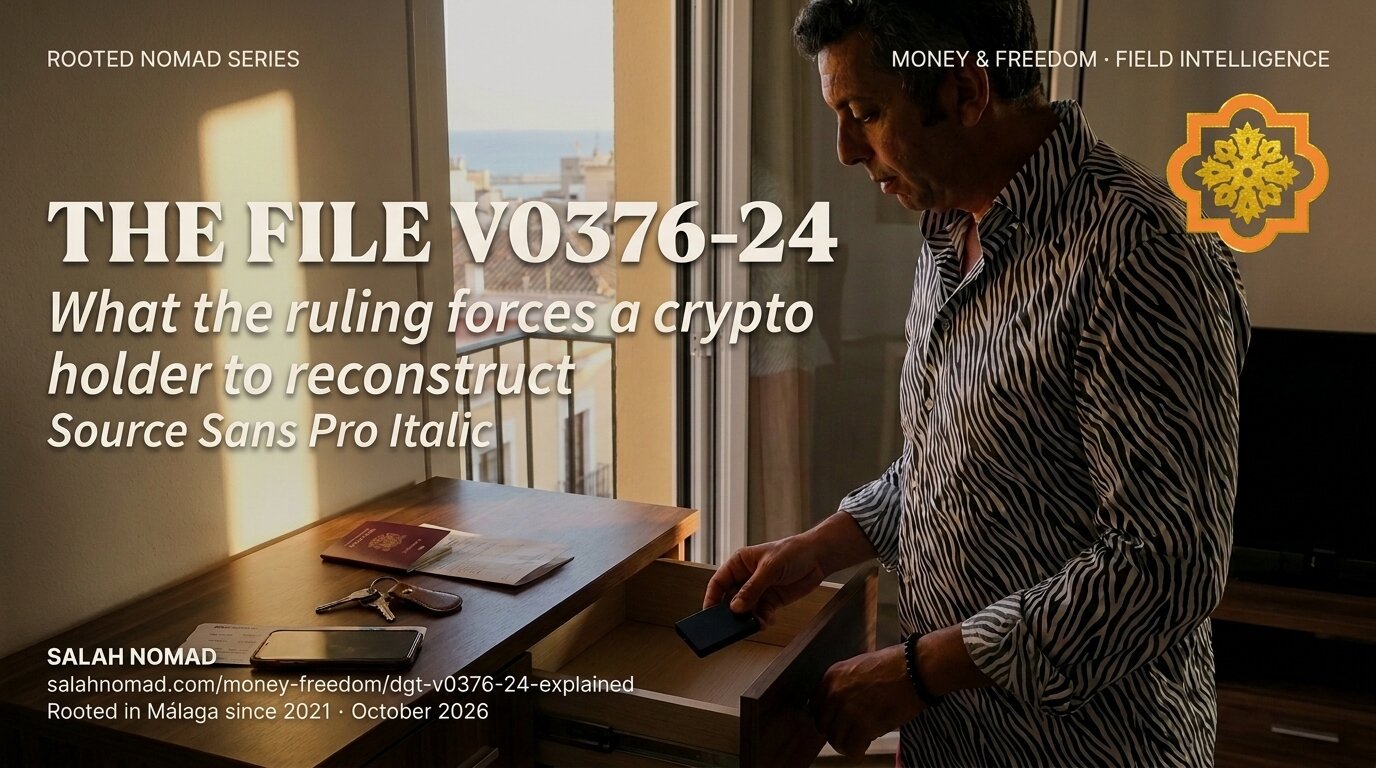
DGT V0376-24 is a 2024 binding ruling from Spain’s Dirección General de Tributos that locates cryptocurrency at the holder’s tax residence under the Beckham Law impatriate regime. It confirms that self-custodied and Spanish-custodied crypto are Spanish-source and taxable at the flat 24% rate, while foreign-custodied crypto without Spanish permanent establishment may remain exempt. The ruling creates no new tax. It creates a documentary obligation that most affected taxpayers have not yet met.
What you need to know: DGT V0376-24 did not just settle the sourcing question. It created a documentary obligation. Every crypto holder who moved assets to self-custody in Spain after becoming tax resident now has a file to reconstruct. Here is what that file contains, how the correction works, and what the AEAT will ask.
Who this matters for: Beckham electees, digital nomads, and residents who moved crypto to a hardware wallet after arrival — and did not declare the sourcing change.
 Crypto Checkout Available
Bitcoin · USDC · Instant PDF delivery
Crypto Checkout Available
Bitcoin · USDC · Instant PDF deliveryThe sideboard was walnut, mid-century, bought at a flea market in El Palo two weeks after I signed the lease. It had one drawer above the shelf, low enough that you had to bend slightly to open it. The brass pull handle had already begun to darken by the time I filled the drawer for the first time.
That was in April. My first Modelo 100 as a Spanish tax resident had been filed six weeks earlier. The Beckham regime had been granted in January. I had moved to Málaga in 2021, and by 2023 I was, on paper, a settled impatriate. Flat 24%. Foreign income exempt. Six years.
The drawer was empty. The Ledger was on the kitchen counter. I put the Ledger in the drawer.
That was the whole gesture. Four seconds. I closed the drawer. I made tea.
Twelve months later, reading DGT V0376-24 for the first time, I understood what I had done.
Not a sale. Not a transfer of ownership. Not a taxable event in the sense I had been taught to dread. A change of location. The ruling was four pages long. It did not need more to say: the location of the asset determines its source, and the source determines the tax.
I had taken my crypto out of the foreign jurisdiction where it had sat since 2017 and put it into the Spanish jurisdiction where it would now be taxed at 24% flat for the remaining years of the regime. Not because I wanted to. Because I did not know the rule existed.
The correction took three weeks.
What V0376-24 says, in four sentences
The ruling is short. It answers one question. Everything in this article follows from four statements.
Spanish tax law locates movable assets by physical location, not by ownership. A painting is located where it sits. A share is located at the issuer’s domicile. A deposit is located at the financial institution.
Cryptocurrency is a movable asset. It is not a share. It is not a deposit. It is not real property. It falls into the same broad family as a work of art — an asset whose location is determined by the person who holds it.
Under the Beckham regime, the exemption for foreign-source income applies to foreign-located assets. Spanish-located assets are taxable at the flat 24%, regardless of the source of the underlying funds.
Self-custody is a location. A Ledger at a Spanish address is a Spanish location. A foreign exchange without Spanish permanent establishment is a foreign location. The move from one to the other changes the sourcing status of the asset, and the change is not neutral.
Four statements. No ambiguity. No interpretive gap left for the taxpayer.

The re-sourcing event
The move I made had a name in the ruling’s logic, though not in its text. Practitioners now call it a re-sourcing event.
A re-sourcing event occurs when an asset moves from one sourcing jurisdiction to another. In practice for a Spanish resident, it occurs when crypto moves from a foreign platform to a self-custody device at a Spanish address, or when it moves from a self-custody device in one country to a self-custody device in Spain.
The ruling does not say the event is a disposal. It is not. There is no gain to declare at the moment of the move. What the event changes is the sourcing of future gains. From the arrival date, the asset is Spanish-located. Every euro of gain from that point is Spanish-source.
For a Beckham electee, that means the exemption stops applying to that specific asset. The asset itself has not been sold. It may never be sold. But if it is — next month, next year, in four years — the gain is taxable at 24%. Not exempt. Not foreign-source. Spanish.
The distinction matters because most Beckham electees who arrive with crypto hear the same sentence: foreign income is exempt for six years. The sentence is true. What the sentence does not say is that the exemption applies to foreign-sourced income, and that the source of crypto is not fixed at acquisition. It moves with the asset.
The file the ruling assumes you already have
V0376-24 is a sourcing ruling. It is not a filing requirement in itself. But it creates one, because the AEAT can only audit what it can see.
The AEAT’s visibility comes from three sources. First, your own filings — Modelo 721 above €50,000, Modelo 720 for other foreign assets, Modelo 100 for disposals. Second, your bank’s reporting. Third, from 2027 onward, the CASP data flowing through DAC8.
If you have moved crypto to self-custody in Spain after arrival, and you have not declared the sourcing change, three things are true. The Modelo 721 already discloses your foreign holdings. The self-custody device is not disclosed, because the 721 only covers foreign custody. The DAC8 data will not disclose it either, for the same reason — the CASP reports what it holds, not what you hold.
The gap is that the AEAT has information pointing to a portfolio, and no information explaining where the portfolio went. When the AEAT has a portfolio and no destination, it asks. The question arrives as a requerimiento.
What arrives attached to the requerimiento is a document request. What it asks for is a sourcing file.

The four ways a sourcing file fails
I built my file three times before it was correct. Each version failed for a different reason. Each failure taught me what the file has to do.
The file fails when the exchange no longer exists. Two of my six exchanges had shut down by the time I started reconstructing. Their account statements, transaction histories, and account balances are gone. On-chain data recovers the transfers, but not the internal accounting. The reconstruction has to be assembled from blockchain explorers, old bank statements, emails, and — in one case — a screenshot I had saved in 2021 to a folder I had forgotten about.
The file fails when the transfers are not labeled. A transfer from an exchange to a Ledger is a single blockchain transaction. It says nothing about which exchange the crypto came from, or what year, or what its cost basis was. Reconstructing the history requires matching each on-chain deposit to a specific exchange withdrawal, and then matching that withdrawal to a specific fiat entry or crypto acquisition. This is the longest part of the reconstruction. For a portfolio assembled across five years, it can take days.
The file fails when the EUR valuation uses the wrong timestamp. The valuation that matters for each disposal is the EUR value at the moment of that disposal, not the current value and not the average cost. For crypto sold or swapped in 2021 or 2022, the EUR value has to come from a source that reconstructs historical prices. I used CoinGecko’s historical API for the primary source and validated against the ECB’s daily reference rate for each date. Where the two sources diverged, I documented the divergence and chose the conservative number.
The file fails when the custody location is not documented. For a self-custody device, the location is where the device sits. Proving it sits in Spain is easy — a photograph of the device with the Spanish address visible in a background utility bill, dated. Proving it sat in a foreign country before the move is harder. A photograph of the device at a foreign address, or a dated receipt from the foreign purchase, or a boarding pass showing the travel, all help. Without at least one piece of dated foreign-location evidence, the pre-move foreign-source position has no foundation.

What the reconstruction looked like
Three weeks. Not full-time — the reconstruction was done in the evenings and on two weekends. But three weeks of evenings.
Week one — inventory. Every wallet address I had ever used. Not just the Ledger, but the exchange accounts, the software wallets, the old hardware wallets I had replaced, the test wallets that held small amounts and were forgotten. Twenty-three addresses, some active, some dormant, two unknown in origin.
Week two — matching. Each on-chain deposit to a specific source. Each withdrawal to a specific destination. Each transfer between wallets cross-referenced with the exchange histories, the bank statements, the mobile backups. At the end of week two, the chain was complete for 89% of the total portfolio value. The remaining 11% required individual research.
Week three — valuation and file assembly. Each historical disposal priced in EUR at the moment of execution. Each transfer dated. Each custody location documented or bracketed as undocumented. The final file is a 47-page PDF: exchange statements, on-chain screenshots, dated photographs of hardware devices, a valuation spreadsheet, and a covering memo of four pages that explains the reconstruction method and lists the five gaps where evidence was incomplete.
The four-page memo is the most important part. Not because it contains the strongest evidence, but because it acknowledges the weakest. The AEAT accepts a good-faith reconstruction that names its own gaps. It does not accept a reconstruction that pretends to be complete.
What V0376-24 does not resolve
The ruling closes the sourcing question for asset location. It leaves four adjacent questions open. Each is documented in the Beckham Law Codex with the corresponding DGT silence marked as DATA ABSENT.
Staking and yield. When crypto is staked, the source of the reward is not determined by the same localización rule. The reward accrues to the holder, but the place of accrual is contested. No ruling has settled whether staking income is Spanish-source when the validator is abroad but the holder is in Spain.
DeFi positions. LP tokens, bridged assets, vault shares — the classification of a position that is not the underlying asset but is economically equivalent to it. No ruling has settled whether a Spanish holder’s DeFi position is Spanish-located by the localización rule, or classified differently.
Modelo 721 interaction. The 721 declares foreign crypto above €50,000. Self-custody is not covered. The interaction between a self-custody re-sourcing event and the 721 threshold is not addressed by the ruling. Practitioners differ.
Exit tax under Article 95 bis LIRPF. Whether a re-sourced asset is within the exit tax perimeter when the holder leaves Spain. The question is different from the sourcing question and has not been resolved.
The four open questions matter for planning. None of them changes what V0376-24 requires of the file. The file is still the file.
What the reader should do
Three scenarios.
Scenario one: no re-sourcing event yet. You arrived in Spain, you have not moved crypto to self-custody, or you moved it before becoming resident. The ruling affects your future planning. Move the Ledger before you become resident, or leave the crypto where it is, or model the tax consequence of the move before you make it.
Scenario two: a re-sourcing event has occurred, and you have declared it. You moved the crypto after arrival and you reported the source change in the corresponding Modelo 100. You are compliant. Nothing to do. You already have a file — keep it.
Scenario three: a re-sourcing event has occurred, and you have not declared it. This is my case. This is where the correction applies. The correction is a Modelo 100 complementaria for each affected year, filed before the AEAT initiates contact. The complementaria reduces the penalty exposure and demonstrates good faith. Filed after the requerimiento, it does neither.
The window is not infinite. The DAC8 data reaches the AEAT in late 2027 for the 2026 tax year. For gains realized in 2026, the cross-match runs in 2028. For gains realized earlier, the cross-match has already been possible since the 721 filings and the bank reporting — but the DAC8 data closes the last gap.
The reconstruction takes three weeks. The correction takes another two weeks on top. The complementaria is filed in a single afternoon once the file is ready.
What the correction protects
The correction does not eliminate the tax. The tax on the re-sourced gains is due regardless. What the correction changes is the penalty regime: Article 27 of the Ley General Tributaria reduces the penalty for a voluntary regularisation filed before any AEAT action. Without the correction, the penalty regime is Article 191 — the standard infraction regime with a 50% to 150% band.
The correction also closes the evidentiary gap. A file submitted with the complementaria establishes the sourcing position and the reconstruction method in writing. If a query arrives two years later, the file is on record. The answer is a reference, not a reconstruction.
The correction is not a confession of guilt. It is a filing of a position the AEAT has the right to review, submitted in the manner most likely to produce a routine review rather than an audit.

The file does not exist until you build it
The ruling assumes the file. It assumes the taxpayer can produce the exchange statements, the transfer confirmations, the wallet addresses, the valuation history, the custody evidence, the acquisition record, the memo. In the ruling’s logic, the file exists.
The ruling does not consider the alternative. It does not consider the case where the file was never built because the taxpayer did not know it was required.
V0376-24 changed the requirement. If you are in Spain under Beckham and you moved crypto to self-custody after arrival, the file is now expected. If it does not exist, it has to be built.
Three weeks of evenings. A spreadsheet with twenty-three rows. A 47-page PDF with a four-page memo that names the gaps.
That is what the correction looks like. That is what the ruling assumes you already have.
Read the ruling. Build the file. Sleep at night.
This article is the second in the series on crypto, tax, and sovereignty in Spain. Read the pillar first: Beckham Law & Bitcoin — the sourcing rule that silently taxes crypto expats.
The full operational protocol — 108 pages, 10 chapters, 4 case files, including the seven-component reconstruction template — is in the Beckham Law Codex.




Comments