

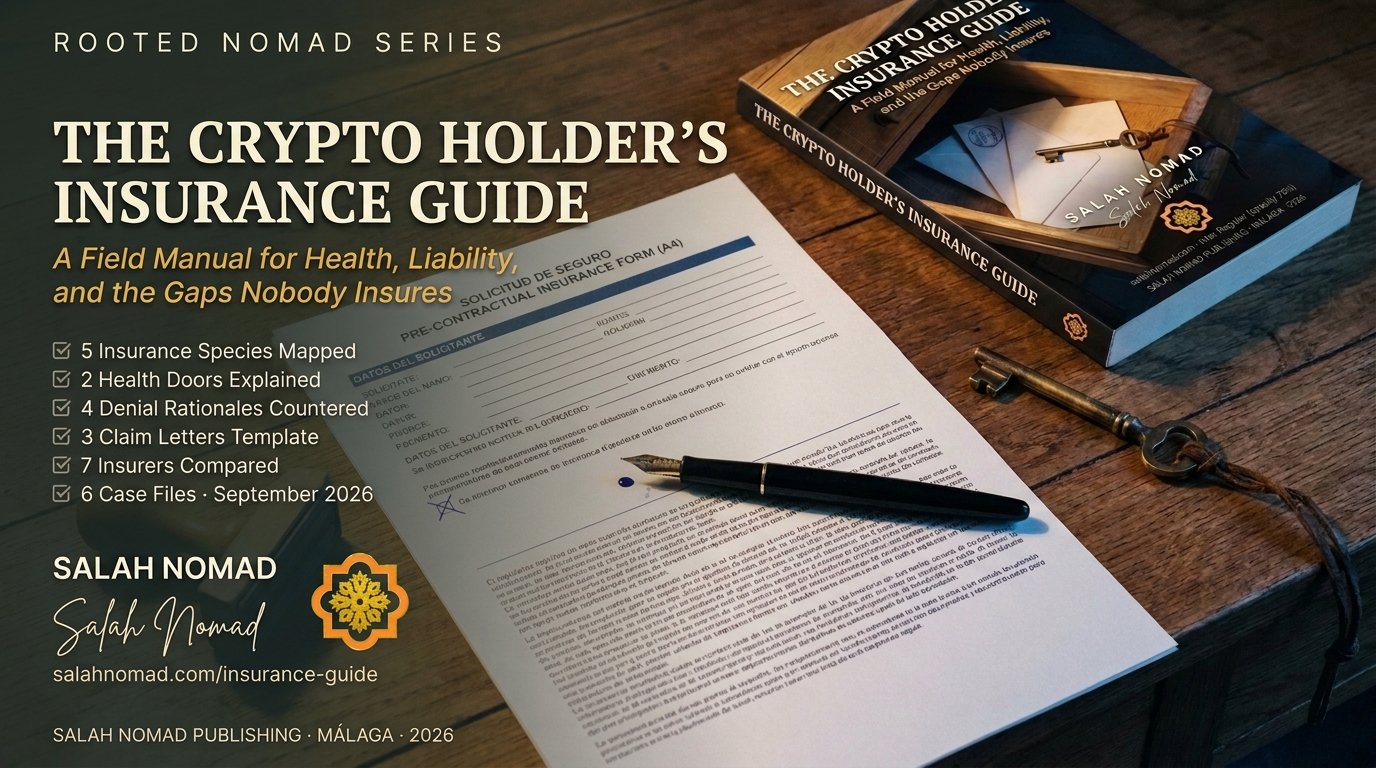

Spain’s insurance system does not see a crypto holder. It sees a risk class, a pre-contractual questionnaire, and a contents schedule — all drafted before your income structure existed. The mismatch is not a conspiracy. It is a template, applied mechanically. And it is the reason a clean tax file and a clean banking file still produce a denied claim.
This guide makes your insurance file legible to the underwriter on the day the policy is signed — and defensible on the day the claim is filed.
🛡️ What This Guide Solves
The two doors into Spanish healthcare. The Convenio Especial de Asistencia Sanitaria (€60/month under 65, €157 at 65+, RD 576/2013, one continuous year of residence plus padrón) versus the private policy — and the 1,080-day myth that costs readers a year of waiting on the wrong instrument.
The declaration trap. The four questionnaire answers — profession, income, activity, prior claims — that decide whether a claim is paid or voided under Ley 50/1980 Art. 10. The exact Spanish wording for each.
The observaciones declaration. A pre-contractual annex in procedural Spanish (Appendix B) that discloses crypto income as rendimientos del capital mobiliario without pushing your file into the trader risk class.
The retroactive-date gap. The RC Profesional clause that left a Barcelona developer with €300,000 of personal exposure after a client’s GDPR fine — and how to negotiate prior-acts coverage at every renewal.
Electronic-device sub-limits, insurer by insurer. Mapfre (5% of furniture sum, €6,000 cap on the Todo Riesgo Tecnológico rider), Mutua Madrileña (€1,500 per claim), AXA (optional schedule, €100 franchise), Zurich GO (€6,000 high-value threshold). Why your €40,000 hardware wallet is paid out as a €1,500 laptop.
The crypto exclusion mechanic. Why home policies exclude crypto value even without naming it: coverage is restricted to bienes materiales, and “money” is defined as legal-tender currency. Insure the object, budget for the arrangement.
Life payouts versus legítimas. The imputation order (tercio libre, mejora, legítima estricta), the notarial acta, and the professio juris election under EU 650/2012 that preserves your beneficiary designation.
The four-rung denial ladder. SAC (2 months) → Defensor del Asegurado (30-90 days) → DGSFP (90 days consumer / 4 months otherwise) → courts. Plus the Art. 3 caracteres destacados counter that overturns denials on procedural grounds alone.
Three claim letters in procedural Spanish (Appendix C), drafted for rungs 1-3, ready to adapt and send.
Six case files with exact numbers. The €9,200 appendectomy, the €280,000 client fine, the €59,000 uninsured crypto, the €130,000 redirected payout, the €2,800 DGSFP reversal, the 112% post-claim repricing.
📘 Inside the Manual
Inside This Codex — 12 Chapters
The four ways a crypto holder pays out of pocket
Health, liability, home, life, travel — and the two Convenios
Convenio vs private policy; the first-year timeline
The four questionnaire answers; observaciones language
RC Profesional tiers, retroactive date, cyber liability
Sub-limits per insurer; crypto exclusion mechanics
Legítimas, notarial acta, professio juris
The four-rung ladder; the Art. 3 counter
The composite post-claim repricing pattern
15 insurers compared; Spanish declaration; 3 letters
❓ Questions Readers Ask Before Buying
Is the Convenio Especial really €60 per month?
Does my home insurance cover a stolen hardware wallet?
I hold a Digital Nomad Visa. Do I need private health insurance?
Can an insurer void my policy because I earn in crypto?
My claim was denied. What do I do first?
Does the Beckham Law sort out my health coverage?
📂 Reads Well With
The Crypto Holder’s Bank Playbook — the fiat rails this guide’s claims ultimately pay into.
The Crypto Freelancer’s Autónomo Playbook — RETA registration is the public-coverage door this guide assumes.
The Crypto Inheritance Framework — the legítimas and professio juris mechanics, extended to the whole estate.
Before You Land — the pre-arrival tax positioning that makes the Appendix B declaration consistent.
The companion volume
Before You Land prepares your crypto for the Spanish threshold. The Insurance Guide protects what you have built after you have crossed.
A note from the medina I am a publisher, not a lawyer, not a fiscal advisor, not an insurance broker. Nothing on this site is legal, fiscal, or insurance advice. Verify every premium, every exclusion clause, and every statutory reference with a qualified professional at the moment of contracting. That is not a legal sentence I hide behind. It is the philosophy, repeated one more time.
“The harbour master does not fear the ship with clean papers.”
— Salah Nomad

Comments