


You are a Spanish tax resident. You hold crypto in self-custody or on exchanges. You have heirs. You have not yet resolved how they will access what you leave them.
Every free guide you have found stops exactly where the problem begins.
The wallet survives you. The access does not — unless you designed it to. The blockchain does not need you alive to keep working. Your seed phrase, your exchange accounts, your self-custody architecture — none of them transition to your heirs on their own. If they are not prepared before death, the portfolio is visible on-chain for the rest of time and reachable by no one. The AEAT still knows it exists. The heirs still owe tax on it. They cannot touch it.
This manual is the procedure that closes that gap — before it opens.
🗂️ What This Framework Solves
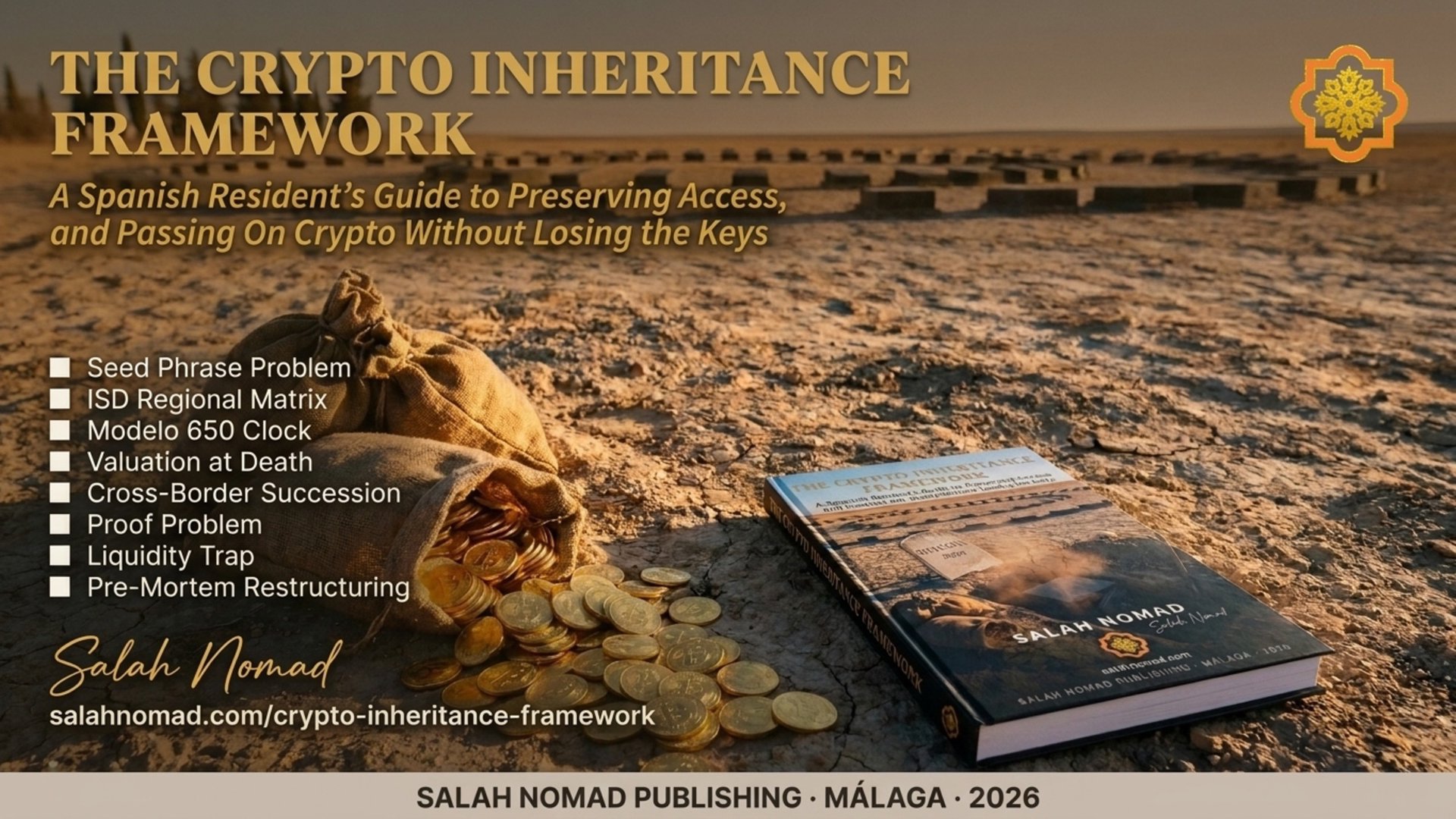
The seed phrase problem. Three architectures exist — single-signature with a dead-man switch, multisig with named co-signers, and Shamir Secret Sharing — and each one is correct in a different estate range. The wrong one is worse than none. The book walks the decision tree and the rehearsal cadence.
The ISD regional matrix. Spain has seventeen inheritance tax regimes plus two foral systems. The same €2M estate in 100% crypto generates a €20,000 ISD bill in Andalucía and a €220,000 bill in Cataluña for the same family. The book explains why, region by region.
The six-month clock. Modelo 650 is not a formality — it is a payment obligation due six months from the date of death, extendable by six more, on request. The book walks the exact sequence: NIF acquisition, valuation methodology, filing, justificante, escritura.
The liquidity trap. The heirs owe the ISD in euros within six months. The crypto is frozen pending the escritura. The escritura requires the ISD to have been paid. The circular dependency is total, and the book names the three escape hatches — the fiat reserve, the life insurance wrapper, and the inter-vivos donation with a five-year horizon.
Cross-border succession. EU Regulation 650/2012 lets a foreign national elect their own national law via professio juris — a single clause in a valid will. Without it, Spanish legítimas apply, and two-thirds of the estate is reserved to the descendants regardless of what the will intended.
The proof problem. A Spanish notary cannot verify wallet ownership. The acta de manifestación binds NIF to public address before death. Without it, the heir must reconstruct possession from on-chain forensics.
Pre-mortem restructuring. The trap can be defused. The book details the fiat liquidity buffer, the donation timing rule that neutralizes gifts within three years, and the corporate wrapper that shifts succession from crypto to shares.
The case files. Eight real autopsies — the ledger in the desk drawer, the €240,000 line item that collapses to €2,400, the NIF that took fourteen weeks, the family home in Málaga sold to cover a €1,200 tax bill.
📘 What’s Inside
Inside This Codex — 12 Chapters
Three architectures, the notary layer, the rehearsal cadence
State baseline, group classification, Andalucía / Madrid / Cataluña
Deadline mechanics, NIF precondition, filing sequence
Evidence hierarchy, multi-exchange divergence, self-custody rule
EU 650/2012, professio juris, the collision
On-chain evidence, acta de manifestación, the notary's refusal
The circular dependency, the three failure points, the pre-mortem solutions
Fiat buffer, inter-vivos donations, corporate wrapper, annual review
Wallet inventory, valuation sheet, Modelo 650 checklist, letter to heirs, NIF sequence
DGT rulings, four modeled questions, tracking sheet
97 pages. 6×9 format. Same design system as the five books already in the Rooted Nomad collection.
The Legal Note, In Advance
This is a framework, not legal advice. Spanish succession law is technical and jurisdiction-specific. Every layer ends with the same recommendation: engage a Spanish abogado and a notario before any act with legal consequence. The book prepares you to brief them with precision. It does not replace them.
FAQ
Do I need to hold crypto in self-custody to benefit from this framework?
Is this the same as the Source of Funds Dossier?
What if my heirs are not in Spain?
Does this cover the Beckham Law?
What if my portfolio is under €200,000?
How long is the framework?
The Rest of the Shelf
This is the sixth book in the Rooted Nomad collection. The others close earlier loops:
- Before You Land — prepares your crypto for the Spanish threshold before you cross it.
- The Crypto Holder’s Bank Playbook — keeps your money working when a bank closes the door.
- The December 31st Protocol — keeps your holdings visible when the AEAT holds up the mirror.
- The Source of Funds Dossier — teaches you to prove the origin of what you hold.
- The Crypto Freelancer’s Autónomo Playbook — registers, invoices, files, defends, and exits the autónomo status.
The full collection lives at salahnomad.com.
The Crypto Inheritance Framework. 97 pages. First Edition, September 2026. Sixth book in the Rooted Nomad collection.
Updates logged at salahnomad.com/crypto-inheritance-framework/updates/.

Comments