

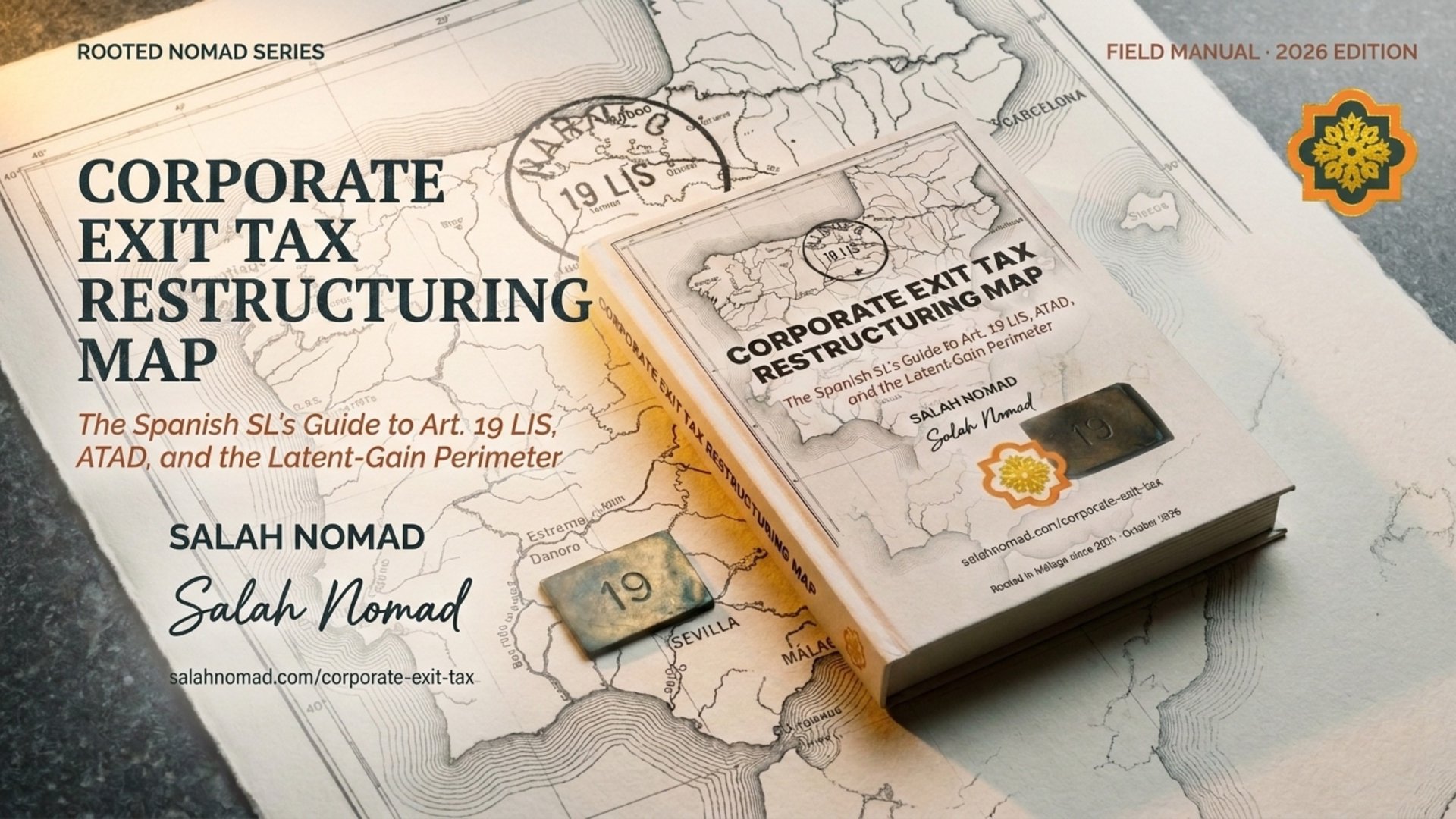

A Spanish SL with €2,000,000 in Bitcoin on its balance sheet decides to move its effective management to Luxembourg. The directors treat the move as administrative — a change of address, a new board resolution, a lease in Luxembourg City. The AEAT reads the same move as a transfer of assets out of the Spanish fiscal perimeter, with a latent gain of €1,800,000 on the crypto alone. The tax bill: €450,000, payable in the year of the move.
This is not a hypothetical. It is Article 19 of the Ley 27/2014 del Impuesto sobre Sociedades, the Spanish transposition of Article 5 of ATAD. It has been in force since 2021. It has been applied by the AEAT in audits across 2024, 2025, and 2026. And it does not apply to the personal exit tax under Article 95 bis LIRPF — the two regimes address different taxpayers, different thresholds, and different asset classes. Most English-language guides on the Spanish exit tax describe Article 95 bis LIRPF and Article 19 LIS as if they were the same regime. They are not.
🗂️ What This Codex Solves
The perimeter. Article 19 LIS, Article 5 ATAD, and the categorical distinction from the personal regime of Article 95 bis LIRPF. The absence of a threshold — any Spanish corporate taxpayer transferring any asset with a latent gain out of the Spanish fiscal perimeter triggers the provision. The cession temporaire clause. The three features Spain added to the ATAD framework.
The five trigger events. Transfer of residence. Transfer of assets to a foreign permanent establishment. Cessation of a Spanish EP. Cross-border merger with loss of Spanish tax residence. Liquidation with transfer of assets abroad. Plus the two events that do not trigger — the Spanish EP exclusion and the temporary transfer.
Latent gain calculation. Market value under Article 18 LIS. Fiscal value. The FIFO rule applied to crypto. The worked example with an 18-BTC + 400-ETH + 600,000-USDC treasury. The €2,176,000 latent gain and the €544,000 exit tax on the crypto component alone.
The crypto component. DGT V0666-25 excludes conventional cryptocurrencies from Article 95 bis LIRPF. This exclusion does not extend to Article 19 LIS. A Spanish SL holding a crypto treasury transfers the full latent gain into the corporate exit tax base when its effective management leaves Spain. Documented with a worked example and the 2026 stablecoin treatment.
Restructuring before the trigger. The neutral regime of Articles 76-89 LIS. The contribution-cessation operation. The twelve-month interval that separates a valid two-stage restructuring from a single integrated transaction. The four-element substance test. The three issues the restructuring does not solve.
Deferral and payment. The five-instalment schedule under Article 19.3 LIS for EU/EEA destinations. The absence of interest. The conditions the deferral requires. The revocation trigger — any subsequent transfer of assets outside the EU/EEA during the deferral period. Why Switzerland and the UAE do not qualify.
Destination selection. Luxembourg, the Netherlands, Portugal, Switzerland, the UAE. Five dimensions of comparison — corporate tax rate, EU/EEA membership, deferral availability, treaty with Spain, substance requirements, AEAT scrutiny. The four-element substance test applied across all destinations. The six-step relocation sequence.
Post-exit compliance. The four-year shadow residency window. The AEAT 2026 Control Plan’s four audit triggers. The three declarative obligations that survive the move — Modelo 200, Modelo 720, annual deferral reports. The interaction with the personal exit of the shareholders. The three-element defense protocol.
📘 What’s Inside
Inside This Codex — 12 Chapters
Art. 19 LIS, Art. 5 ATAD, and the distinction from Art. 95 bis LIRPF. The two regimes side by side. The cession temporaire clause.
Five events, two exclusions, and the AEAT's four audit configurations. The branch that triggers Event 2.
Market value under Art. 18 LIS. Fiscal value. The crypto component with worked examples. The valuation documentation that survives an audit.
The neutral regime of Arts. 76-89 LIS. Contribution-cessation. The twelve-month interval. The substance test. What restructuring does not solve.
The five-instalment deferral. The absence of interest. The reporting obligations. The early revocation case.
Luxembourg, the Netherlands, Portugal, Switzerland, the UAE. The comparison matrix. The substance question. The six-step relocation sequence.
The four-year shadow residency window. Four audit triggers. Declarative obligations. Defense protocol. Retention and archival.
Software SL with crypto treasury, real estate holding, mixed family office. Numbers preserved.
Five destinations, six dimensions, plus the five-instalment deferral applied.
Primary legislation, DGT rulings, case law. Verification status by claim with DATA ABSENT markers.
Do I need crypto to benefit from this Codex?
Is this the same as the Beckham Law Codex?
What's the difference between Art. 19 LIS and Art. 95 bis LIRPF?
Why is the crypto exclusion from Art. 95 bis not applicable to Art. 19?
Can the exit tax be deferred?
How does the twelve-month interval work?
How long is the Codex?
📂 Read Next
The Beckham Law Codex — the personal side of the same taxpayer profile. Article 93 LIRPF, the 24% flat rate, the crypto sourcing rule, and the personal exit planning protocol for years 5-6. → salahnomad.com/beckham-law-codex/
The Beckham Codex handles the individual. This Codex handles the SL. Both matter for a shareholder considering a relocation.
The Crypto Payroll Playbook — the corporate compliance manual for SLs paying contractors in stablecoins. The B2B framework, the withholding mechanics, the AEAT reporting obligations. → salahnomad.com/crypto-payroll-playbook/
The Payroll Playbook handles the ongoing corporate crypto activity. This Codex handles the exit from Spain.
The companion volumes
The Corporate Exit Tax Restructuring Map is the ninth book in the Rooted Nomad collection. The other volumes close the earlier and adjacent loops:
Read Before You Land → — prepares your crypto for the Spanish threshold. Read The Crypto Holder’s Bank Playbook → — keeps your money working when a bank closes the door. Read The December 31st Protocol → — keeps your holdings visible when the AEAT holds up the mirror. Read The Source of Funds Dossier → — teaches you to prove the origin of what you hold. Read The Crypto Freelancer’s Autónomo Playbook → — registers, invoices, files, defends, and exits the autónomo status. Read The Crypto Inheritance Framework → — passes on self-custodied and exchange-held crypto without losing the keys. Read The Beckham Law Codex → — resolves the personal impatriate regime and the crypto sourcing rule. Read Spanish Wealth Tax & Crypto → — the patrimony side of the same taxpayer profile.
“The marginal corporate tax rate differential between Spain and Luxembourg is 0.06 points. The exit tax on a €2M crypto treasury is 25 points on the latent gain. The two figures are not comparable in the same decision.”
— Salah Nomad
The Corporate Exit Tax Restructuring Map. 86 pages. First Edition, October 2026. Ninth book in the Rooted Nomad collection.
Updates logged at salahnomad.com/corporate-exit-tax/updates/.

Comments