

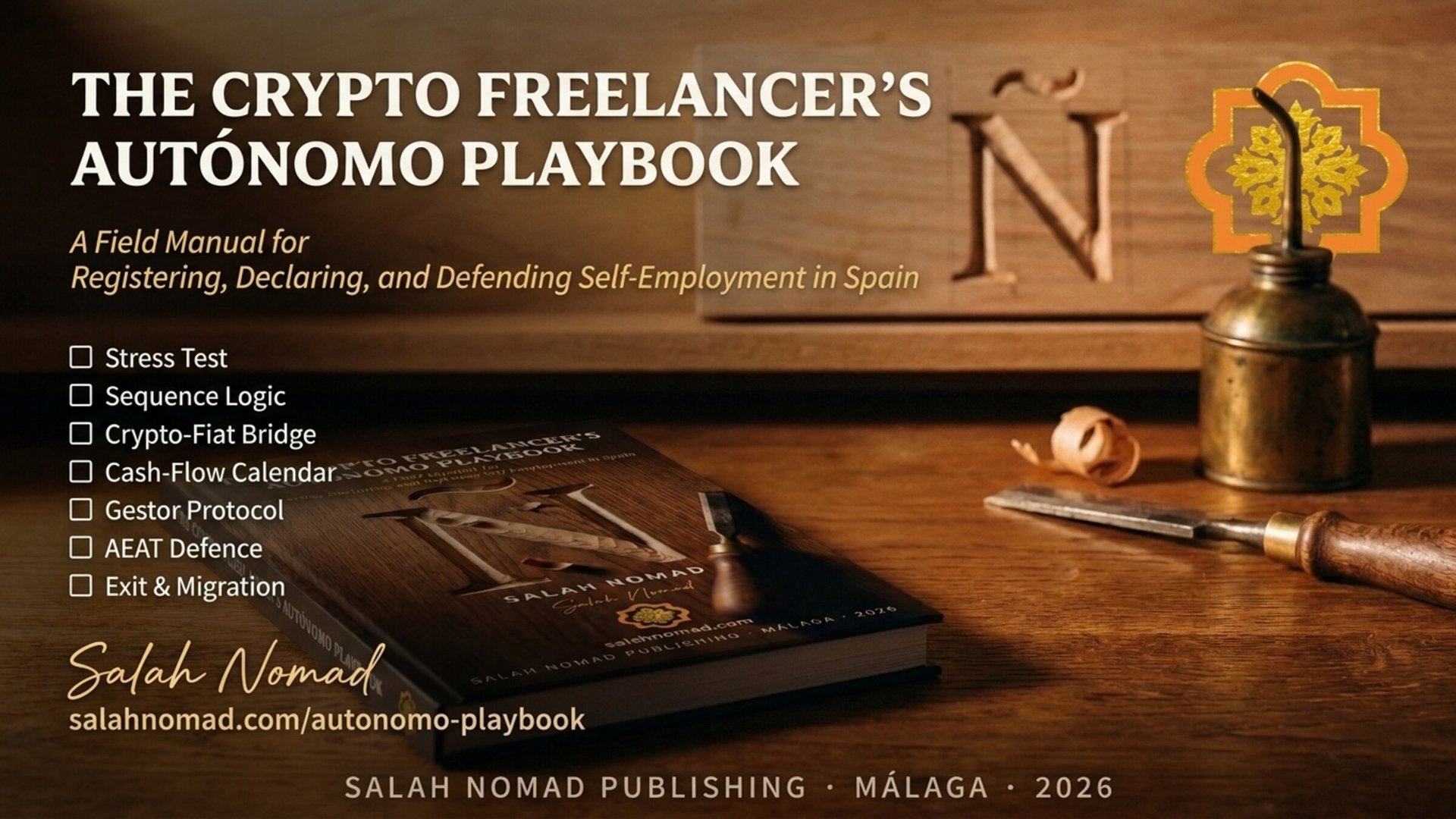

You are a freelancer. Your clients pay in stablecoins. You are about to register, or you have just registered, as an autónomo in Spain.
Every free guide you have found stops exactly where your problems begin.
The cover carries a single carved letter: Ñ. It is the only character in the Spanish alphabet that belongs to no other language. It is what Spain asks you to add to your own name, your own status, your own paperwork, before it lets you work legally on its soil. The playbook teaches you how to carve it.
🗂️ What This Playbook Solves
The seven layers. Stress Test, Sequence Logic, The Crypto-Fiat Bridge, Cash-Flow Calendar, Gestor Protocol, AEAT Audit Defence, Exit and Migration. Each layer answers a specific question the Spanish tax authority and the Seguridad Social are legally required to ask. The order is not arbitrary. It mirrors the sequence of the compliance cycle.
The autónomo-to-SL decision tree. The 60,000 € figure you read elsewhere is a dangerous simplification. The real threshold depends on one variable most guides ignore: how much profit you must extract to live.
The IAE epígrafe selection. The code that decides your quarterly cash flow. Professional epigraphs carry 7%/15% withholding. Business epigraphs carry none, but require Modelo 130 prepayments instead.
The crypto-fiat bridge. Invoicing in stablecoins or BTC. The EUR conversion source that survives audit. The VAT place-of-supply table. The Beckham Law and Modelo 721 intersection. Four gray zones flagged explicitly, with modeled consulta vinculante questions in Spanish legal register.
The RETA regularisation trap. The January and February bill that hits first-year autónomos. The provisioning formula: 28% to 35% of gross. Two bases, two rates. General base for activity income. Savings base for crypto gains.
The gestor protocol. The seven-question vetting grid. The responsibility allocation that survives an AEAT review. The exit clause.
The AEAT audit defence. Four procedures and their clocks. Four crypto-specific triggers: the DAC8 cross-matching gap, the Modelo 721 omission, DeFi classification inconsistency, permuta valuation gaps. The written-only response principle. The conservative-basis rule.
Exit and migration. Status changes. Residence changes. The exit-tax question under Article 95 bis LIRPF.
📘 What’s Inside
Inside This Codex — 11 Chapters
Whether you should register at all, and as what. The falso autónomo checklist. The autónomo-to-SL decision tree. The fixed-cost floor most guides ignore.
The dependency chain from NIE to DEHú. The IAE epígrafe that decides your quarterly cash flow.
Invoicing in stablecoins or BTC. The VAT place-of-supply table. The Beckham Law and Modelo 721 intersection. Four gray zones flagged.
The five deadlines. The provisioning formula. The RETA regularisation trap that hits in February.
When to hire one. The seven-question vetting grid. The exit clause that survives an AEAT review.
Four procedures and their clocks. Four crypto-specific triggers. The written-only response principle.
Status changes. Residence changes. The exit-tax question under Article 95 bis LIRPF.
Printable, fillable. From the falso autónomo self-assessment to the exit and migration checklist.
How to file a binding opinion with the DGT. Five modeled questions in Spanish legal register.
Do I need to own crypto to buy this playbook?
Is this the same as the Source of Funds Dossier?
What is a gray zone, and why are there five?
Does this cover the Beckham Law?
How long is the playbook?
Can I read it before I move to Spain?
The Crypto Freelancer’s Autónomo Playbook. 61 pages. First Edition, September 2026. Fifth book in the Rooted Nomad collection.
Updates logged at salahnomad.com/autonomo-playbook/updates/.

Comments